
National
AI Stocks Tumble as U.S. Midterm Elections Send Shockwaves Through Global Markets
By Current Editor
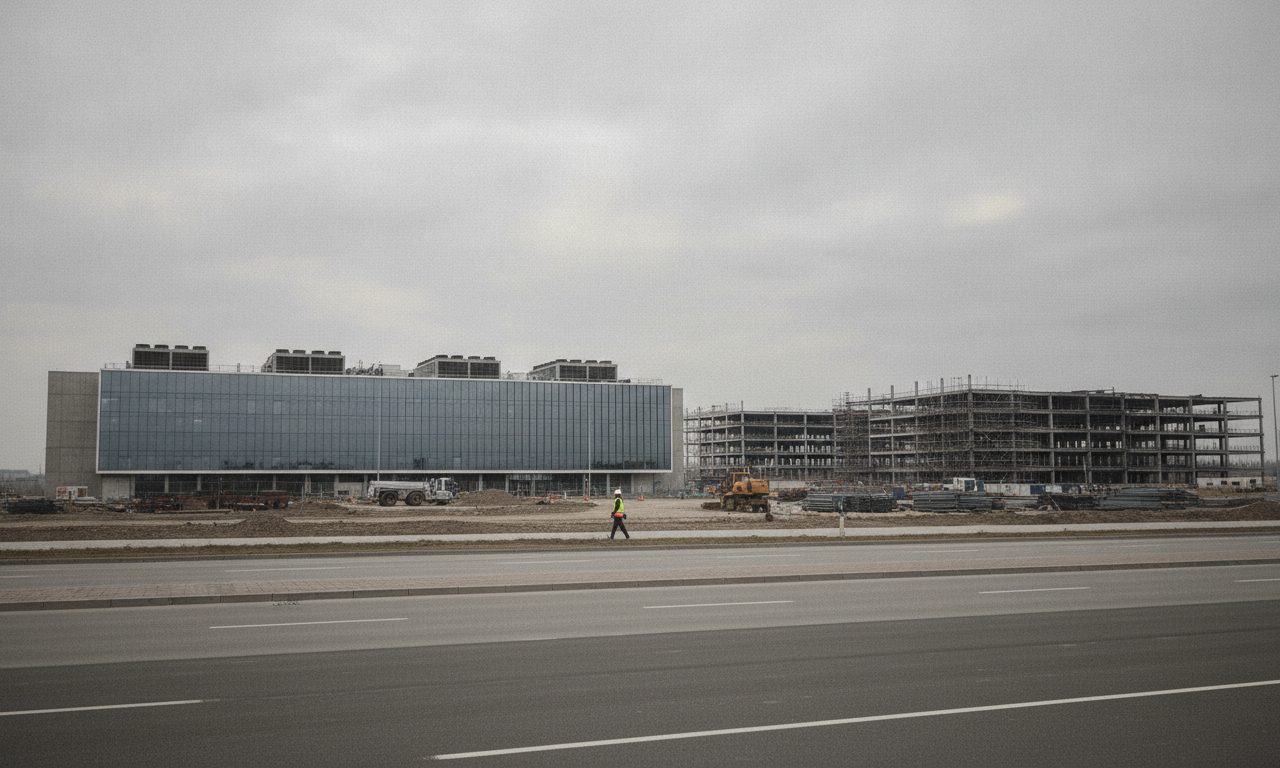
Democratic victories in Washington raise questions about the future of artificial intelligence, data centre expansion and the billions being invested in the technology boom.
By The Current News Desk | November 5, 2026
The artificial intelligence boom that has helped drive global stock markets to extraordinary heights is facing a new and unexpected challenge: American politics.
Following Tuesday’s U.S. midterm elections, technology stocks have come under renewed selling pressure as investors reassess the future of an industry that has attracted hundreds of billions of dollars in investment.
The Democrats’ sweeping victory, which delivered control of both the House of Representatives and the Senate, has introduced a new political reality for President Donald Trump and the technology companies that have benefited from expectations of a business-friendly regulatory environment.
The question facing investors is no longer simply whether artificial intelligence will transform the global economy.
It is whether political opposition, regulatory intervention and growing public resistance could slow the industry’s expansion before investors see the financial returns they have been promised.
Wall Street Reacts to a Political Shift
The market’s reaction has been anything but uniform.
On Wednesday, the Dow Jones Industrial Average surged more than 1,500 points, while the S&P 500 gained 1.6%, as investors welcomed the prospect of divided government and potentially fewer sweeping policy changes.
But beneath those headline gains, companies involved in building the infrastructure required to power artificial intelligence suffered significant losses.
Shares of data centre operators, semiconductor companies and technology infrastructure providers came under pressure.
The selloff extended into Asian markets Thursday, with South Korea’s Kospi dropping 5.3% and Japan’s Nikkei 225 losing nearly 2%.
Major technology companies, including Samsung Electronics, SK Hynix and SoftBank Group, were among those affected.
The contrast reveals an important distinction: investors may be comfortable with the broader political outcome while simultaneously questioning the future profitability of the AI expansion.
Did the Midterms Change the AI Investment Story?
There is growing evidence that the election results have become a significant factor in the technology selloff.
Democratic candidates in several states campaigned on stronger oversight of artificial intelligence, restrictions on data centre construction and greater accountability for the electricity and water consumed by these facilities.
Those concerns are no longer theoretical.
The election results have strengthened politicians who favour slowing or restricting certain developments, particularly in communities where residents are concerned about rising electricity costs and infrastructure demands.
For investors, that creates a potentially serious problem.
Artificial intelligence companies depend on an enormous expansion of computing capacity. That requires new data centres, electrical infrastructure, advanced semiconductors and substantial amounts of capital.
If governments delay construction approvals, impose new operating requirements or restrict access to energy infrastructure, the financial assumptions behind some of these investments could change dramatically.
UBS analysts have estimated that approximately 30% of expected U.S. data centre capacity additions in 2028 could be exposed to potential construction pauses.
That does not mean those projects will be cancelled. But it introduces uncertainty into an industry whose valuations depend heavily on rapid expansion.
Importantly, Congress does not directly control every data centre approval. State governments, municipalities, utilities and local permitting authorities will continue to play a central role.
Nevertheless, a Democratic-controlled Congress could increase scrutiny through hearings, investigations and negotiations over federal policy.
The Bigger Problem: Has AI Become Too Expensive?
Politics may have accelerated the selloff, but it is not the only explanation.
For months, investors have questioned whether the enormous capital expenditures being committed to artificial intelligence can generate sufficient returns.
Technology companies are spending heavily on computing infrastructure, specialized processors, electricity and facilities.
Yet the commercial returns from many AI applications remain uncertain.
This creates a difficult equation.
If infrastructure spending continues accelerating while revenue growth fails to meet expectations, investors may begin questioning valuations that assume years of extraordinary profitability.
Political restrictions would only compound that challenge.
There is also a distinction between the largest technology companies, which have substantial cash reserves, and smaller infrastructure operators that rely more heavily on borrowing and outside investment.
A slowdown in construction could affect those businesses very differently.
The election may therefore be exposing financial vulnerabilities that already existed beneath the enthusiasm surrounding artificial intelligence.
Oil, Interest Rates and the Trump Factor
The political shift is also influencing markets beyond technology.
Oil prices fell sharply Wednesday as investors considered whether a Democratic-controlled Congress could increase pressure on the Trump administration to reduce American involvement in the conflict with Iran.
Brent crude, the international oil benchmark, dropped substantially before recovering some ground Thursday.
Defence contractors also faced selling pressure amid speculation that future military spending could encounter greater congressional resistance.
Meanwhile, U.S. Treasury yields stabilized after earlier declines, reflecting a market attempting to determine how the election will influence government spending, inflation and future interest-rate decisions.
For President Trump, the midterm results represent a significant change in the political environment.
The administration will face a Congress more willing to investigate executive decisions, challenge spending priorities and scrutinize relationships between government and major corporations.
Companies closely associated with Trump and prominent Republican supporters, including Elon Musk, may face additional political attention.
However, increased scrutiny does not automatically translate into new legislation or restrictions. The White House retains significant powers, and congressional Democrats will still face legislative and political constraints.
What Does This Mean for Canada?
For Canadian investors and businesses, the implications extend well beyond movements on Wall Street.
Canada has positioned itself as an attractive destination for artificial intelligence investment, supported by relatively abundant energy resources, a growing technology sector and established research capabilities.
If American data centre development encounters greater regulatory obstacles, some international investors could consider Canadian alternatives.
That could create opportunities for British Columbia, Alberta, Quebec and other provinces seeking investment in computing infrastructure and energy development.
But Canada would also face challenges.
Large-scale AI infrastructure requires reliable electricity, transmission capacity, suitable industrial land and predictable approval processes.
British Columbia, in particular, must consider how growing electricity demand from data centres would interact with existing industrial needs, housing growth and energy development.
There is also a financial risk.
Canadian pension funds, institutional investors and individual shareholders have substantial exposure to American technology markets.
A prolonged correction in AI valuations could affect Canadian investment portfolios, even if the underlying technology continues advancing.
A Warning for the Technology Industry
The message emerging from the U.S. midterms may be larger than a temporary stock market correction.
For years, the artificial intelligence industry has operated on the assumption that technological advancement and investment would move faster than political intervention.
That assumption is now being challenged.
Voters are increasingly asking who benefits from massive technology developments, who pays for the required infrastructure and whether local communities should have greater control over expansion.
Those questions are becoming political issues rather than simply economic considerations.
For investors, the implications are clear.
The future of artificial intelligence will depend not only on technological breakthroughs but also on energy availability, public acceptance, regulatory certainty and the ability to deliver measurable financial returns.
The November midterm elections did not create all the concerns surrounding the AI investment boom.
But they may have brought those concerns into sharper focus.
The technology revolution is not necessarily slowing down. The political and financial conditions supporting its expansion, however, may be changing much faster than investors anticipated.
And that is something markets around the world can no longer afford to ignore.
To send a tip or ask about advertising, write to [email protected] or call 250-317-5888.