LOCAL
Trillion-Year Precision: University of Toronto Unveils World’s Most Accurate Atomic Clock


Key Takeaways
- University of Toronto physicists have engineered a revolutionary atomic clock, setting a new benchmark for precision timekeeping.
- This groundbreaking device is touted as potentially the most accurate clock on the planet.
- Its unparalleled stability could allow it to operate for 3 trillion years without deviating by a single second.
- The breakthrough promises significant advancements across various scientific and technological domains, from navigation to fundamental physics.
The Deep Dive
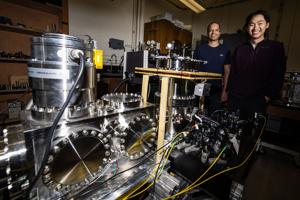
A dedicated team of physicists at the University of Toronto has achieved a monumental breakthrough in metrology, developing an atomic clock that redefines the very concept of precision. This innovative timepiece leverages the incredibly stable quantum properties of atoms to measure time with an accuracy previously thought unattainable. Unlike traditional clocks, which rely on mechanical or electrical oscillators, atomic clocks use the exact frequency of electromagnetic signals that atoms emit or absorb when transitioning between energy states, providing an extremely consistent ‘tick.’The researchers claim their creation could maintain perfect time for an astonishing 3 trillion years without losing or gaining even one second. This level of stability far surpasses existing atomic clocks, which are already the world’s most accurate timekeepers. The engineering challenge involved in isolating the atomic transitions from environmental interference and precisely measuring them is immense, requiring cutting-edge laser technology and quantum manipulation techniques to achieve such extraordinary consistency.
Why It Matters
The development of such an incredibly precise atomic clock holds profound implications across numerous fields. Improved timekeeping accuracy directly enhances the performance of satellite navigation systems like GPS, enabling more precise location tracking and guidance for everything from autonomous vehicles to air traffic control. It also forms the backbone of modern telecommunications, ensuring synchronized data transmission across global networks. Scientifically, this new clock opens unprecedented opportunities for testing fundamental theories of physics, such as Einstein’s theory of general relativity, with greater rigor. It could also contribute to the search for dark matter, the detection of gravitational waves, and potentially lead to a redefinition of the international standard for the second, pushing the boundaries of human knowledge and technological capability.