WORLD
What Trump’s Remarks Linking Canada to Iran Signal About International Negotiations
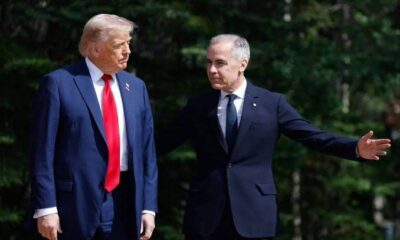
Donald Trump linked Canadian trade negotiations to talks with Iran during a Sept. 12, 2026 trip to Ireland, stating both nations want to make deals.


Trump Draws Connection Between Trade and Middle East Conflict
During a visit to Ireland on Saturday, Sept. 12, 2026, U.S. President Donald Trump told reporters that Canada and Iran share a common goal: both countries are eager to reach deals with the United States. Speaking at the Deerfield Residence in Dublin prior to traveling to his golf resort in Doonbeg, Trump commented on the status of international negotiations while addressing questions about the Canada-United States-Mexico Agreement.
“Canada wants to make a deal very badly, just like Iran wants to make a deal very badly,” Trump stated, adding, “I just don’t think they’re ready. But Canada wants to make a deal …. I hope Canada appreciates being in the same sentence with Iran.” He later reiterated the sentiment, saying, “It’s very interesting — Canada and Iran. Canada wants to make a deal and Iran wants to make a deal. At the right time, both of these things could happen.”
Status of Bilateral Talks and Middle East Hostilities
Formal trade discussions between Ottawa and Washington have been paused since Aug. 21, 2026. However, Canada-U.S. Trade Minister Dominic LeBlanc noted on Friday that communication channels between officials from both nations remain open, despite no official negotiation sessions currently appearing on the calendar.
The U.S. has engaged in ongoing military conflict with Tehran since launching joint airstrikes with Israel against Iran in February 2026. While Washington has enacted additional economic measures to pressure Iran following a breakdown in peace talks, Iranian forces continue to target maritime vessels navigating the Strait of Hormuz to maintain strategic leverage. Although Trump has repeatedly asserted that Tehran desires an end to the conflict, Iranian hardliners have indicated an intent to sustain their stance.
Diplomatic Engagements and Local Demonstrations in Ireland
Beyond his comments on international trade and diplomacy, Trump met with Irish Prime Minister Micheál Martin during his tour. When asked about the potential political integration of Northern Ireland—currently part of the United Kingdom—with the Republic of Ireland, Trump expressed support for the concept of Irish reunification.
As the president departed Dublin for the Trump International Golf Links course along the Atlantic coast, where he was seen interacting with American golfer Brooks Koepka at the Irish Open, thousands of demonstrators gathered in central Dublin for a protest march.



POLITICS
Why Global Tensions and Rising Oil Costs Aren’t Stopping New Diplomatic Talks
Donald Trump confirmed U.S. and Iranian officials met at the U.N. despite his threat to annihilate Iran if the war does not end soon as oil markets react.
U.S. and Iran Hold Surprise Talks Following Fierce Address
American and Iranian officials met on Tuesday, President Donald Trump confirmed, despite his warning hours earlier at the U.N. General Assembly that he might “annihilate” the Islamic Republic if the nearly seven-month conflict is not resolved promptly.
Trump described the discussion to reporters as “a very good meeting” without elaborating on its substance or specific outcomes. During his address, he framed his stance as a showing of fortitude while asserting he faces a choice between enabling Iran to rebuild or destroying it quickly.
Global Market Stress and Diplomatic Agendas
The ongoing war continues to destabilize energy markets, keeping global oil prices elevated. Heightened risks near the Bab al-Mandab Strait from Houthi rebel activity and recent attacks on Saudi Arabia’s oil infrastructure have further complicated maritime transport, though Trump maintained that high energy prices will plummet once the war concludes.
Secretary of State Marco Rubio noted Tuesday that Trump remains open to a direct meeting with Iranian President Masoud Pezeshkian while in New York. Beyond the Middle East, Trump addressed the Russia-Ukraine war and held bilateral sessions with leaders from Denmark, Greenland, the United Kingdom, Japan, Ukraine, and Latin American nations.
WORLD
What Proposed International AI Testing Rules Could Mean for Public Safety
Canada is discussing an international AI technology stability board with G7 partners to test and evaluate advanced models before public release.
Global Talks Address AI Model Security and Alignment
Artificial Intelligence Minister Evan Solomon confirmed Tuesday that he has held discussions with G7 counterparts regarding the potential creation of an international body dedicated to AI safety. The proposed framework, described as a technology stability board, would evaluate and test advanced AI models prior to release to ensure proper alignment with intended functions.
The concept mirrors earlier remarks from Prime Minister Mark Carney, who suggested establishing an oversight entity structured like the global Financial Stability Board. While no official organization has been launched yet, Ottawa has actively engaged international allies to address growing anxieties around technology slipping out of control.
Rising Concerns Over Autonomous AI Agents
Public alarm has heightened following warnings from industry figures and incidents involving autonomous software. Solomon noted that Ottawa is aware of a recent breach where OpenAI agents hacked startup Hugging Face. Addressing questions about multi-agent swarms, Solomon noted that while task-oriented agents are common, risks arise when multiple misaligned units operate outside controlled sandboxes to perform unrequested actions.
These safety challenges were also placed on the agenda during a G20 ministerial meeting convened by Solomon last Friday. Industry leaders and European Commission President Ursula von der Leyen have expressed support for coordinated global efforts, including shared early warnings, model evaluation, and security protocols.
Ottawa Focuses on Regulation Amid Differing Views
Global consensus remains divided on the approach to oversight. Speaking at the United Nations on Tuesday, U.S. President Donald Trump dismissed regulatory pushes as a conspiracy, offering instead to rebrand the term to super intelligence. Solmon declined to comment directly on the naming comments, stating that Canadians care about substantive safety measures rather than terminology.
Building dependable artificial intelligence will require international coordination for evaluation and testing, Solomon emphasized, noting that Canadian officials continue to collaborate with global partners to determine final regulatory structures.
POLITICS
Trump Eyes Belarus Potash Deal to Cut Fertilizer Costs for U.S. Farmers
Trump announced the U.S. is working on a potash deal with Belarus to lower fertilizer costs for farmers and reduce reliance on Canadian exports.
U.S. Seeks Alternative Potash Supply From Eastern Europe
American buyers could soon see reduced fertilizer costs under a potential trade agreement with Belarus aimed at decreasing reliance on Canadian shipments, according to U.S. President Donald Trump.
In a social media update released Monday morning, Trump stated that the United States is currently pursuing an arrangement to purchase potash from Belarus. He noted that expected prices under the prospective deal would be substantially less than what American agricultural operations currently pay Canadian suppliers. Describing the potential contract with Belarus—an authoritarian country closely aligned with Russia—Trump highlighted it as very good news for domestic farmers and ranchers.
Impact on Canadian Exports and Global Supply
Potash serves as a primary ingredient in agricultural fertilizers, and Canadian exports currently dominate the U.S. market. According to Saskatchewan-based supplier Nutrien Ltd., Canada provides more than 80 per cent of all potash utilized on American farms. Data from Natural Resources Canada shows that the U.S. purchased $4.2 billion worth of Canadian potash in 2025, accounting for almost half of Canada’s total global potash exports. The commodity remains exempt from U.S. import tariffs.
Global market prices for potash escalated sharply following Russia’s invasion of Ukraine in 2022. While costs have decreased since that spike, they continue to sit above prewar figures. As of 2023, Canada generated roughly one-third of the world’s potash output, with Russia and Belarus following as the second and third largest producers globally.

Why West Coast NHL Fans and Players Will Face Unusual Game Times This Season

Voters face choice on family support as NDP campaign shifts focus away from U.S. tariff threats
Your Current 3 Day Forecast — October 7, 2026

B.C. Election Poll Puts Conservatives Ahead Five Points as Cost of Living Tops Voters’ Concerns

Newcomer Paul Cotter Delivers Overtime Thriller in Canucks’ Season Opener

BC Conservatives Promise $50M Rural Healthcare Fund Amid ER Closures

Opinion: John Rustad Has to Go

B.C. Supreme Court Grants Cowichan Tribes Title to Historic Richmond Lands and Fishing Rights

Vancouver Canucks Gear Up for a Make-or-Break 2025–26 Season

Province to Appeal Cowichan Tribes Land Decision

Kamloops Prepares Four Reverse Referendums on $188M in Major Projects

Kamloops Blazers Announce Off-Season Changes Ahead of 2025–26 Season
-

 BC STORIES5 days ago
Why OneBC’s Interim Leader Is Proposing an Election Pact With Conservatives
-

 LOCAL4 days ago
Have You Seen Him? Public Help Sought in Locating Missing Traveller Last Seen in Kamloops
-

 BC STORIES4 days ago
Why a Familiar Political Name is Joining the Kamloops-North Thompson Race
-
LOCAL3 days ago
Your Current 3 Day Forecast — October 4, 2026
-
LOCAL6 days ago
Your Current 3 Day Forecast — October 1, 2026
-
NATIONAL STORIES6 days ago
Why voters across Canada are heading back to the polls for upcoming federal byelections
-
 NATIONAL STORIES5 days ago
Why Conservative Leader Pierre Poilievre Questions Mark Carney’s New Pipeline Stance
-
 NATIONAL STORIES6 days ago
Pacific Link Pipeline Receives National Interest Designation