WORLD
A Sunrise of Solace: Bondi Beach Stands United in Defiance After Tragedy
A comprehensive report on the sunrise vigil at Bondi Beach where thousands gathered in solidarity and defiance following a local massacre.

A Morning Like No Other
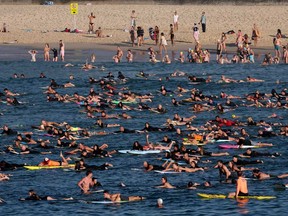
As the first amber rays of the sun pierced the horizon over the Tasman Sea, the usual rhythmic sounds of the Bondi surf were replaced by a heavy, collective silence. On Monday morning, thousands of Sydneysiders descended upon the iconic crescent of Bondi Beach, not for the usual fitness rituals or tourist snapshots, but to stand in a human wall of grief and resilience. The massacre that had shattered the peace of the Eastern Suburbs just days prior remained etched on every face, yet the atmosphere was one of quiet defiance rather than defeat.
The gathering, organized through word-of-mouth and community social media groups, drew a crowd that reflected the vast diversity of Sydney. Families with young children, elderly residents who have called the coastline home for decades, and the vibrant surfing community stood shoulder to shoulder on the cooling sand. The visual was striking: a sea of black-clad mourners stretching from the North Bondi rocks all the way to the historic pavilion. It was a physical manifestation of a community refusing to be defined by a single act of violence, choosing instead to be defined by their response to it.
The Circle in the Deep
In what was perhaps the most poignant moment of the morning, hundreds of board riders took to the water. In a tradition deeply rooted in surf culture, usually reserved for the passing of a local legend, surfers paddled out beyond the break. Forming an enormous, unbroken circle on the surface of the Pacific, they held hands, their boards bobbing on the gentle swell. This ‘paddle-out’ served as a powerful metaphor for the strength of the community: individually vulnerable, but collectively unbreakable.
From the shore, the circle appeared as a ring of protection around the grieving suburb. As the surfers splashed water into the air and let out a collective cry that echoed against the headlands, those on the beach responded with a somber applause. For many, the ocean has always been a place of healing, and on this morning, it became a sanctuary for a city in mourning. The water, which had seen so many generations of joy, was now a vessel for the city’s shared sorrow.
A Community Defined by Solidarity
The tragedy, which occurred at a nearby shopping hub, had left the city reeling, questioning the safety of public spaces that had always felt like second homes. However, the sunrise vigil sought to reclaim that sense of security. Local community leaders, though choosing to remain mostly silent to let the moment speak for itself, noted that the turnout exceeded all expectations. The presence of so many people at such an early hour was a testament to the fact that the bonds of the Eastern Suburbs are far deeper than a shared postcode.
As the sun rose higher, the crowd did not immediately disperse. People stayed to embrace strangers, share quiet stories of where they were when the news broke, and lay flowers near the shoreline. The ‘solace and defiance’ mentioned by organizers was visible in the way the community held its ground. There was no anger in the air, only a profound sense of shared humanity. The massacre had sought to tear the fabric of the city, but the sunrise at Bondi suggested that the stitches were only being reinforced.
Moving Toward Healing
While the physical scars of the event will take time to heal and the investigations into the tragedy continue, the morning at Bondi Beach provided a crucial first step in the psychological recovery of the city. Psychologists and community advocates have long noted that collective rituals are essential in the wake of mass trauma, allowing individuals to process their shock within a supportive framework. By gathering shoulder to shoulder, the people of Sydney sent a clear message to the rest of the world: they are a community that looks after its own.
As the vigil concluded and the surfers returned to the shore, the usual life of Bondi began to slowly resume. But it was a different kind of morning. The coffee shops were quieter, the greetings between neighbors more meaningful, and the look in people’s eyes a bit more determined. The enormous circle in the ocean eventually broke as surfers caught waves back to the sand, but the unity it represented remained. The massacre was a dark chapter, but as the sun climbed into a clear blue sky, it was evident that the light of the community would not be extinguished. Bondi stood firm, a beacon of hope for a city beginning the long journey toward peace.


WORLD
Ebola Crisis Escalates in Central Africa as Cases Surge 40% in One Week
Ebola cases jump 40% in a week as the Bundibugyo virus spreads in Congo and Uganda. Health officials warn of a funding crisis and a lack of vaccines.

A Rapidly Expanding Outbreak
The Ebola outbreak currently tearing through the Democratic Republic of Congo and Uganda has reached a critical tipping point. Africa’s Centres for Disease Control and Prevention (Africa CDC) reported on Thursday that confirmed cases have surged by nearly 40 percent in just seven days, bringing the total number of deaths to over 200 within the first month. With 894 confirmed cases to date, health officials warn that this is the most aggressive start to an outbreak ever recorded, surpassing the 2000 Uganda outbreak by three-fold.
The Threat of the Bundibugyo Strain
Compounding the severity of the crisis is the specific nature of the pathogen involved. This outbreak is fueled by the rare Bundibugyo virus, a strain of Ebola for which there are currently no approved vaccines or treatments. Unlike the more common Zaire virus, which dominated previous outbreaks and can be managed with existing stockpiles, the Bundibugyo strain presents a significant challenge to medical responders. While experimental monoclonal antibody treatments are being fast-tracked for development, healthcare workers are currently limited in their clinical options.
Conflict and Displacement Hamper Response
The epicenter of the crisis is Congo’s Ituri province, a region crippled by years of civil conflict. According to the United Nations, nearly a million people have been displaced in the area, creating a nightmare for contact tracers. Dr. Wessam Mankoula, a medical epidemiologist at Africa CDC, noted that while experts estimate between 17,000 to 35,000 potential contacts require monitoring, less than 15 percent have been successfully tracked. The combination of dense forests, poor infrastructure, and the movement of thousands of miners makes containing the virus across the Congo-Uganda border an uphill battle.
A Critical Shortfall in Funding and Personnel
Despite the international community pledging over $900 million to combat the virus, only a fraction of those funds—roughly $90 million—has actually been released. This financial bottleneck is directly impacting the ground response; Africa CDC estimates a need for 540 specialized personnel, yet only 84 are currently deployed. As the virus continues to spread into new health zones, officials are calling on global partners to honor their financial commitments before the window for containment closes entirely.
Economics
Mark Carney Hails U.S.-Iran Framework as ‘Game Changer’ for Global Stability
Prime Minister Mark Carney calls the U.S.-Iran framework a ‘game changer’ at the G7 summit, detailing its impact on nuclear security and global oil supplies.

A Potential Turning Point at the G7 Summit
In a high-stakes reveal during the G7 summit in France, Prime Minister Mark Carney described a preliminary framework agreement between the United States and Iran as a significant “game changer” for Middle Eastern stability. Speaking with CNN’s Kaitlan Collins, Carney confirmed he has reviewed the unpublished document, stating the deal has “exceeded expectations” in its scope to end a 100-day conflict that has paralyzed global energy markets.
The Core of the Agreement
While the full terms remain confidential, the framework reportedly establishes a 60-day window for intensive negotiations regarding Iran’s nuclear program. Carney emphasized that the deal “sets the groundwork to ensure Iran doesn’t have a nuclear weapon,” suggesting that a critical metaphorical “Rubicon” has been crossed. Key components of the agreement include the reopening of the Strait of Hormuz—a vital corridor for approximately 20 million barrels of oil daily—and the lifting of a blockade that has sent global fuel prices skyrocketing.
Canada’s Expanding Role
Beyond endorsing the peace process, Carney signaled that Canada is prepared to play a logistical and financial role in the deal’s implementation. This includes potential assistance with demining efforts in the Strait of Hormuz and navigating the complex process of unfreezing Iranian assets. Carney noted that Canada could help mitigate global reliance on economic choke points by leveraging its own resources in oil, gas, and critical minerals. “One of the big lessons here is don’t be held hostage to one choke point in the global economy,” Carney remarked.
Regional Concerns and the War in Ukraine
Despite the optimism, the deal faces scrutiny for excluding key regional players like Israel and Hezbollah from the preliminary talks. Carney remained vague on how the agreement impacts Israel’s military presence in Lebanon, though he noted it provides a foundation for a future solution. Shifting focus to Europe, Carney also characterized G7 discussions on Ukraine as “constructive,” announcing new sanctions against 162 Russian entities and asserting that the tide of the war has turned against President Vladimir Putin.
National Security
FBI Thwarts Explosive Drone Plot Targeting UFC Event at White House
The FBI has foiled a domestic terror plot involving explosive drones and mass shooting plans targeting a UFC event on the White House South Lawn.

Unsealed Documents Reveal Complex Attack Plan
Federal law enforcement officials have disrupted a sophisticated domestic terrorism plot aimed at a high-profile mixed martial arts event held on the White House South Lawn this past weekend. According to court documents unsealed Tuesday, a group of individuals planned to use explosives-laden drones and firearms to target the UFC show attended by high-ranking officials and President Donald Trump.
The Nature of the Threat
The FBI discovered the plot after gaining access to encrypted communications between approximately 20 participants. The group, which reportedly communicated via TikTok and the SimpleX chat app, allegedly planned to fly drones into the event to create a diversionary explosion. The suspects then intended to open fire on the panicked crowd as they attempted to flee the area. FBI Director Kash Patel confirmed that a multi-state operation led to several arrests, effectively stopping the planned attacks "cold."
Motivations and Arrests
The group, identifying themselves through online circles such as "Vanguard of the Old," expressed deep dissatisfaction with the current state of the U.S. government. Affidavits suggest the suspects believed the country needed to be "torn down so that it could be rebuilt." Among those in custody is Tycen Proper, a 19-year-old from Ohio, whose own mother alerted authorities after becoming concerned by his firearm purchases and interactions with individuals claiming to be ex-military.
Broader Political Targets
In addition to the UFC event, investigators found that members of the group had discussed targeting specific members of Congress, particularly those with ties to the American Israel Public Affairs Committee (AIPAC). Despite the intended scale of the violence, President Trump, who was attending the G7 summit in France at the time the details were made public, stated he had not yet been briefed on the specifics of the thwarted operation. The investigation remains ongoing as authorities work to determine the full scope of the network.
Maple Leafs Secure Top Pick as NHL Reveals Official 2026 Draft Order
Unfreezing the Market: Carney and Eby Unveil $3.2B Housing and Transit Package
Alberta Affordability Payments: $100 Relief Direct Deposits to Arrive Within Two Weeks
Ebola Crisis Escalates in Central Africa as Cases Surge 40% in One Week
History Made: Canada Records First-Ever World Cup Victory in Dominant 6-0 Rout of Qatar
The End of an Era: CBC to Stop Airing NHL Games as ‘Hockey Night in Canada’ Leaves Free TV

Opinion: John Rustad Has to Go

B.C. Supreme Court Grants Cowichan Tribes Title to Historic Richmond Lands and Fishing Rights

Vancouver Canucks Gear Up for a Make-or-Break 2025–26 Season

Province to Appeal Cowichan Tribes Land Decision

Kamloops Prepares Four Reverse Referendums on $188M in Major Projects

Kamloops Blazers Announce Off-Season Changes Ahead of 2025–26 Season
-
 OPINIONS2 weeks ago
Kerry-Lynne Findlay Won the Leadership. Now She Has to Win British Columbia.
-
National News2 weeks ago
Canada to Ban Social Media for Minors Under 16 as Carney Government Unveils Online Safety Bill
-
Energy & Resources1 week ago
Canada Shifts Energy Policy: Hodgson Declares End of Apologies for Oil Sands Success
-
LOCAL1 week ago
Where to Watch the 2026 FIFA World Cup in Vancouver: Top Bars, Patios, and Fan Zones
-
Canadian News1 week ago
Beyond the Brochures: The Reality of Life in Alberta’s Changing Landscapes
-
POLITICS1 week ago
B.C. Conservatives Overtake NDP in New Post-Leadership Poll
-
Hockey1 week ago
NHLPA Demands Investigation Resumes as Oilers Eye Mike Babcock for Potential Role
-
Middle East2 weeks ago
Fragile Calm Returns as Iran and Israel Halt Direct Strikes Following Trump Intervention