OPINIONS
B.C. Election Poll Puts Conservatives Ahead Five Points as Cost of Living Tops Voters’ Concerns


The BC Conservatives lead the BC NDP 48% to 43% among decided and leaning voters in a new Angus Reid Institute poll. Cost of living is the top concern, named by 57% of respondents, followed by health care at 42%.
By Chad Dashly | The Current
A new Angus Reid Institute poll puts the BC Conservatives five points ahead of the BC NDP, but the closer look is more complicated than the topline suggests: both parties have gained support, voters are beginning to settle on their choices, and the issues they want leaders to address are firmly rooted at home.
The online survey, conducted October 1–3, found that 48% of decided and leaning voters would support the BC Conservatives, compared with 43% for the BC NDP. The poll was released after the nomination deadline finalized most parties’ candidate slates.
The Institute says both major parties gained support during the early campaign. It attributes Conservative gains in part to a smaller pool of CentreBC and OneBC candidates competing across the province, while the NDP appears to be drawing support from the Greens. Those are the pollster’s explanations for the shifts; the results do not establish why individual voters changed their minds.
The survey also found a more settled electorate. Nearly half of respondents, 46%, said they were “very certain” of their vote, up from 35% in the first week of the campaign. That confidence is not evenly distributed: among Conservative supporters, the share who were very certain rose from 47% on September 24 to 65%. Among NDP supporters, it reached 44%, a three-point increase from the campaign’s opening week.
The poll’s issue findings are just as notable. Cost of living and inflation were the leading concerns, selected by 57% of respondents. Health care followed at 42%. The economy and jobs, housing affordability, the provincial deficit and public safety each registered at 24% to 26%.
U.S. tariffs, Donald Trump and the alcohol ban were named as a top voting issue by 10%, down from 15% in the September 22–24 survey. The Institute’s question allowed respondents to choose up to three issues. The numbers suggest that, for many voters, the cost of daily life and access to care are more immediate concerns than the cross-border dispute that featured prominently in the NDP’s case for an election.
What the poll means
The five-point Conservative lead is a snapshot, not a prediction of the final result. The vote-intention figure is based on 846 decided and leaning voters, while the wider survey included 1,013 B.C. adults. Angus Reid says the overall results were weighted to represent the province’s adult population. Its stated margin of error—plus or minus three percentage points, 19 times out of 20—applies to a probability sample of that size; this was an online panel survey, so that comparison should be treated as a guide rather than a guarantee of precision.
The more useful campaign signal may be the contrast between the two parties’ apparent momentum and the issues voters are naming. The Conservatives lead, and their supporters report a marked increase in certainty. But the NDP has also gained ground, and nearly half of respondents still do not describe themselves as very certain. There is room for the race to move.
The issue rankings also set a practical test for both leaders. Voters are pointing to affordability and health care. Broad arguments about leadership, campaign tactics or national politics may draw attention, but parties still have to show how their plans would affect household costs and people’s ability to get care.
In the poll’s results, Conservative leader Lorne Doerkson holds a narrow edge over David Eby on who would make the best premier: 36% choose Doerkson and 33% Eby. Nearly as many, 31%, choose neither. That last figure is a reminder that a lead between party options does not automatically translate into broad enthusiasm for either leader.
As the campaign advances, the question is whether the parties can turn their current support into votes—and persuade uncertain voters that their promises answer the concerns showing up most clearly in the polling.
Source: Angus Reid Institute online survey conducted October 1–3, 2026, among 1,013 B.C. adults. Vote intention is based on 846 decided and leaning voters. Read the poll and methodology.

Save Local Journalism—Including the Voices Outside the Big Chains
By Chad Dashly | Opinion | The Current
When the big newspaper groups warn that local journalism is in trouble, we should listen.
When they ask government to help pay the bills, we should ask questions.
Both are part of a healthy democracy.
B.C.’s community newspaper industry is calling for a greater share of provincial advertising spending to stay with local publishers. Its argument deserves consideration: governments need to communicate with residents, and local news outlets need advertising revenue to keep reporting.
But there is a bigger question behind that request.
Will any new arrangement support a diverse local press, including independent digital publishers, or simply help the largest established players hold their ground?
That distinction matters to every community that wants more than one version of the story.
Journalism belongs to the community
Peter Kvarnstrom reports that Black Press community newspapers and eight Glacier publications produced more than 7,000 election stories and columns during October’s municipal and provincial campaigns. That represents substantial work by reporters helping voters understand their choices.
Those journalists deserve credit. A reporter working for a large chain can be just as committed to their community as someone working for a small independent outlet.
But the number of stories a company publishes does not give it ownership of the public interest.
Independent outlets bring additional questions, different editorial judgments and another place for residents to take concerns. Sometimes they pursue an issue others have overlooked. Sometimes they challenge a comfortable local consensus.
Readers benefit from that competition.
A town with several outlets asking questions has a better chance of getting answers than a town depending on one editorial desk.
Public advertising needs public rules
The industry’s proposal calls for at least 25 per cent of government advertising spending to go to local media. Kvarnstrom has advocated extending that approach to Crown corporations as well.
Let’s be precise: purchasing advertising is a commercial transaction. It is different from handing a newsroom an unrestricted operating grant.
Government has legitimate reasons to buy advertising. Residents need information about public services, road closures, emergency preparedness and programs their taxes support.
The test should be whether that spending reaches people effectively, delivers value and follows fair, published rules.
An independent digital publisher should have a fair opportunity to compete. So should a community newspaper, a local broadcaster or another credible outlet serving an identifiable audience.
Owning a printing press should confer no special claim on taxpayers’ money. Neither should belonging to a large publishing group.
And favourable coverage must never become an unofficial qualification.
Independence requires more than a label
Receiving government advertising does not automatically compromise a newsroom. Refusing it does not automatically make a publication trustworthy.
Independence is demonstrated through conduct: checking facts, correcting mistakes, separating advertising from editorial decisions and asking difficult questions even when the answers might upset someone who pays the bills.
That applies to governments. It also applies to private advertisers, owners and political allies.
Still, any system that puts public officials in charge of allocating revenue to the outlets covering them deserves close scrutiny.
Publish the recipients. Publish the amounts. Explain the selection criteria. Make access fair for smaller publishers.
Public confidence requires that much.
Readers and businesses have a role
Government spending alone cannot provide a durable foundation for independent journalism.
Local businesses make a choice every time they place an advertisement. Readers make one when they subscribe, contribute, share an original report or introduce a publication to a potential advertiser.
Those choices help determine which voices survive.
At The Current, we believe communities deserve reporting and commentary that earn their attention, challenge decisions and give people a reason to stay engaged.
We also believe readers should be able to compare our work with someone else’s.
So yes, take the financial crisis facing local journalism seriously.
But if government changes how it buys advertising, the objective should be a stronger, more varied local press.
The big boys deserve a fair hearing. Independent publishers deserve a fair chance. And the public deserves a press nobody can take for granted.
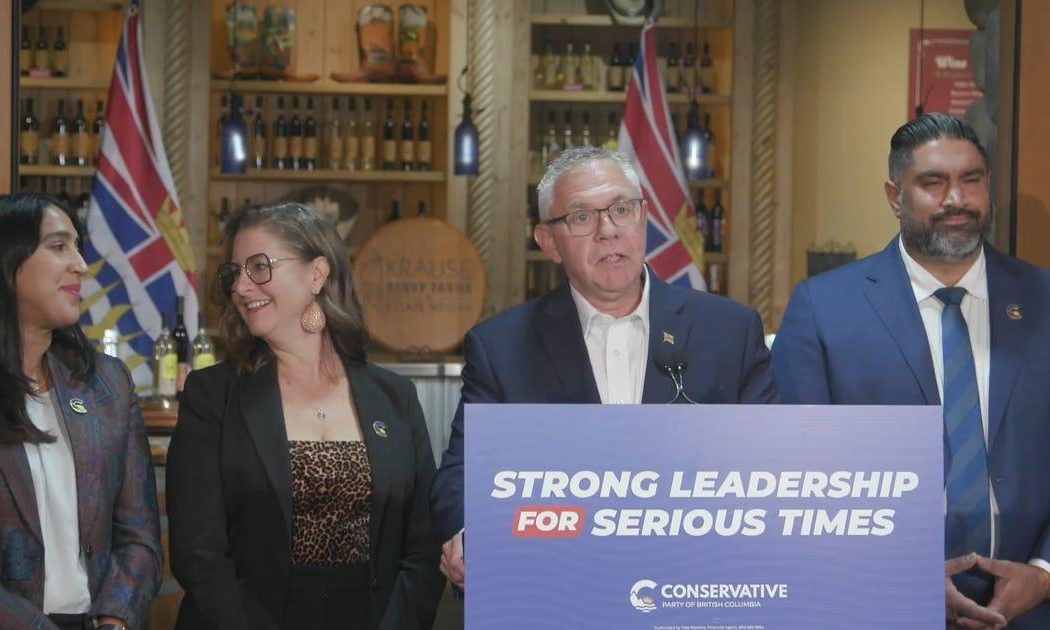
The Money Spoke Before the Voters Did: How B.C.’s Conservatives Turned Chaos Into Victory
By Chad Dashly | The Current | November 5, 2026
There is an old saying in politics: follow the money.
In British Columbia, the money was telling a story long before voters went to the polls on October 24. And if anyone at NDP headquarters was paying attention, they should have been worried.
New third-quarter fundraising figures show the Conservative Party of British Columbia raised approximately $2.73 million, compared with just $986,093 for the NDP.
Nearly three dollars for the Conservatives for every dollar raised by the New Democrats.
But the real story isn’t simply how much money came in. It’s when it arrived — and what that tells us about the extraordinary political transformation British Columbia has just experienced.
From Political Chaos to Political Capital
Only weeks before the election, the BC Conservatives appeared to be doing everything possible to destroy themselves.
Leadership disputes. Caucus defections. Public disagreements. A party seemingly more interested in fighting itself than fighting the government.
Then came September 20.
Kerry-Lynne Findlay resigned as Conservative leader, and Cariboo-Chilcotin MLA Lorne Doerkson stepped into the leadership.
What happened next should become a case study for political strategists across Canada.
Between September 20 and September 30, Conservative contributions totalled approximately $2.45 million — nearly 90 per cent of the party’s entire third-quarter fundraising.
Think about that.
A party struggling to hold itself together suddenly attracted millions of dollars in political contributions in just eleven days.
That doesn’t happen by accident.
It suggests donors who had been sitting on the sidelines were suddenly prepared to invest in a political organization they believed could win.
The change in leadership mattered. So did the prospect of an election. And the Conservatives had something they hadn’t possessed in months: a credible opportunity to unite their competing factions around a common objective.
Winning.
David Eby’s Political Miscalculation
Premier David Eby called a snap election on September 22, two years ahead of the scheduled provincial vote.
The calculation appeared straightforward.
The Conservatives were divided. Their leadership had collapsed. Their caucus had fractured. Surely this was the moment to strike.
Except something had changed.
The Conservative Party that Eby expected to face was rapidly becoming a different political organization.
Doerkson’s arrival created an opportunity for reconciliation among Conservatives who had spent months arguing about personalities, policies and direction.
And the fundraising figures suggest that opportunity resonated.
Meanwhile, the NDP struggled to generate comparable financial enthusiasm.
That is not necessarily proof that donors predicted the election result. Political contributions are influenced by many factors, including campaign timing, organizational strength and individual donor networks.
But the disparity was an unmistakable warning.
Eby may have correctly identified Conservative instability. What he appears to have underestimated was how quickly that instability could turn into unity when the prospect of forming government became real.
The Interior Has Become the Centre of Political Power
There is another dimension to this election that deserves attention.
British Columbia’s political centre of gravity has shifted.
For decades, provincial politics has been dominated by Vancouver, Victoria and the Lower Mainland.
Now a politician from the Cariboo-Chilcotin is preparing to lead the province.
That matters.
For communities throughout the Thompson, Okanagan, Cariboo and northern British Columbia, the election represents an opportunity to bring regional economic concerns directly into the premier’s office.
Forestry. Mining. Natural gas. Agriculture. Transportation infrastructure. Permitting delays.
These are not abstract policy debates for people who live and work outside the Lower Mainland.
They determine whether businesses invest, whether young families can remain in their communities and whether the next generation has meaningful economic opportunities.
Doerkson has promised to make economic development a priority.
The question now is whether his government can turn those promises into measurable results.
Money Can Win Elections. It Cannot Govern.
Conservatives should be careful about celebrating too early.
Preliminary election results give the party 63 of the legislature’s 93 seats, although the final count is still pending.
That is a commanding position.
But a large majority does not automatically produce a successful government.
The same party that recently struggled with internal divisions must now demonstrate cabinet discipline, sound fiscal management and the ability to make difficult decisions.
British Columbians will expect progress on affordability, health care, housing and economic opportunity.
They will also expect accountability.
The Conservatives have promised no new taxes, faster approvals for major projects and stronger support for resource development.
Delivering those commitments while maintaining essential public services will require more than campaign slogans.
It will require serious governing.
The Lesson for Every Political Party
The fundraising numbers reveal something larger than a financial advantage.
They suggest a dramatic change in political confidence.
Donors were willing to back the Conservatives despite the party’s recent turmoil. Voters subsequently handed them a decisive preliminary victory.
For the NDP, the implications are equally significant.
A party that controlled the government machinery and chose the election date was unable to match its opponent’s fundraising momentum.
That demands more than a routine campaign review.
It demands an examination of leadership, organization, voter relationships and the party’s understanding of the province’s changing political priorities.
For the Conservatives, the challenge is different.
They have won the opportunity to govern. Now they must prove they deserve to keep it.
The money may have spoken before the voters did. But from this point forward, British Columbians will judge their new government not by what it raised, but by what it delivers.
Chad Dashly writes political commentary for The Current, examining British Columbia politics, public policy and the decisions shaping communities across the province.
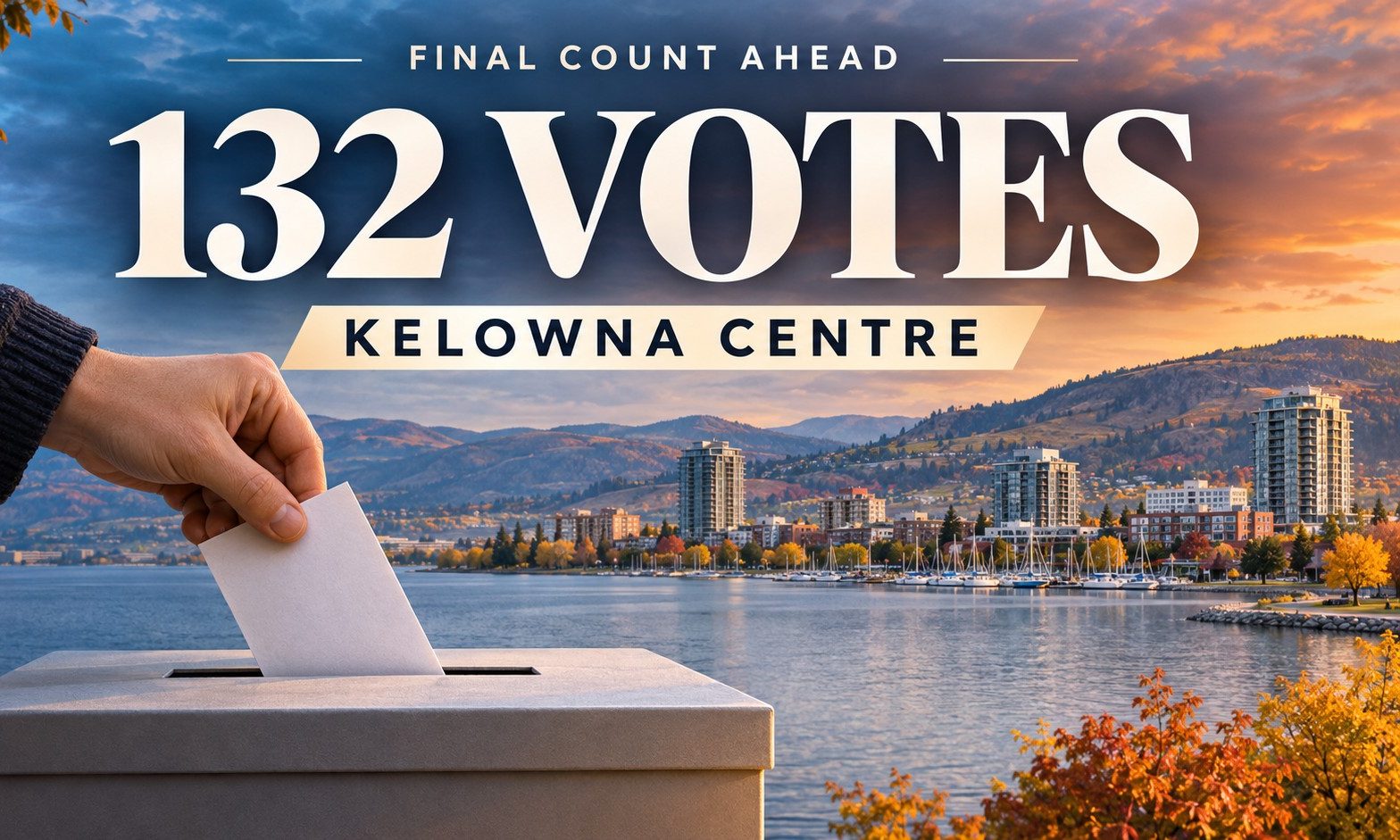
Kelowna Centre’s 132-Vote Warning: Nobody Owns This Riding
Opinion | By Chad Dashly
Kristina Loewen’s narrow lead over Loyal Wooldridge carries a message both parties should hear: voters’ support must be earned, and every ballot matters.
One hundred and thirty-two votes.
That is the gap between Conservative Kristina Loewen and New Democrat Loyal Wooldridge in Kelowna Centre’s initial count. Loewen has 10,791 votes. Wooldridge has 10,659. With final counting still ahead, those numbers describe a lead, not a finished election.
They also deliver a political warning.
Anyone who believes a party can plant its flag in Kelowna Centre and assume the territory belongs to them should take another look at the scoreboard.
This riding requires persuasion. It requires candidates who show up, listen and give people a reason to trust them. And when the votes are this close, the difference between winning and losing can fit inside a few apartment buildings.
For campaign teams, that should be sobering. For voters who have ever wondered whether their ballot matters, it should settle the question.
The count deserves patience
Elections BC has scheduled the final count for November 6–10. Vote-by-mail and other absentee ballots were not included in the election-night count. Those ballots undergo additional eligibility checks before being counted.
Counting them is part of completing the election.
The legitimacy of a ballot does not depend on whether it helps your candidate. Both camps should be capable of saying that clearly before they know the outcome.
Loewen deserves recognition for holding the lead. Wooldridge deserves recognition for remaining within striking distance. Neither observation gives anyone permission to get ahead of the process.
Close elections demand discipline from candidates, parties and commentators alike. Declare what is known. Explain what remains outstanding. Let the count finish.
Conservatives should resist complacency
For Conservatives, the uncomfortable question is straightforward: why is Kelowna Centre still so competitive?
A lead this narrow should prompt a serious examination of local organization, candidate accessibility, voter contact and the strength of the offer being made at the doorstep.
The numbers alone cannot tell us which factor mattered most. They certainly do not establish what every voter intended.
But they do establish that the party has little room for complacency.
Being the Conservative candidate carries an obligation to earn confidence beyond the people already wearing the jersey. Residents need to see someone prepared to work on housing affordability, access to health care, public safety and the conditions facing local businesses.
Those are reasonable standards by which to judge whoever represents this riding.
If Loewen holds the seat, she should treat the result as an instruction to broaden her support. A narrow victory still gives an MLA the full responsibility of office—including responsibility to constituents who voted for somebody else.
New Democrats should ask harder questions, too
Wooldridge’s competitive showing gives the NDP something to examine seriously.
It does not give the party a licence to assume that everyone who supported him endorsed every provincial policy carrying the NDP label. Voters can support a candidate for several reasons: personal confidence, local relationships, party loyalty or concern about the alternatives.
Sorting those reasons out takes listening.
If Wooldridge falls short, the useful response will be to identify where confidence was earned and where it remained out of reach. Coming close can be the foundation for future success. It can also become an excuse to avoid changing anything.
The party should be careful which lesson it chooses.
The third candidate’s voters belong to themselves
OneBC candidate Bill Desrosiers received 873 votes in the initial count—well above the gap between the two leading candidates.
That will invite arguments about vote splitting.
The arithmetic is obvious. The assumptions require more care.
Those ballots cannot simply be reassigned to the Conservatives in an imaginary two-candidate contest. Some voters might have chosen Loewen. Others might have stayed home or made a different choice.
Parties frustrated by another candidate’s support should ask why those voters wanted another option. Their votes must be earned, too.
Kelowna Centre has delivered a useful reminder to everyone in politics: a riding is a community of people making individual decisions.
Finish counting their ballots. Respect the result. Then get to work earning a little more trust than you had before.
At 132 votes, there is precious little room to take anyone for granted.
Your Current 3 Day Forecast — November 15, 2026
Your Current 3 Day Forecast — November 14, 2026

What to Know as Severe Rainfall Warnings and Flooding Hit Vancouver Island Communities
Your Current 3 Day Forecast — November 13, 2026
Your Current 3 Day Forecast — November 12, 2026
McDavid Reaches Point Milestone as Oilers Edged Flyers in Overtime Thriller

Opinion: John Rustad Has to Go

B.C. Supreme Court Grants Cowichan Tribes Title to Historic Richmond Lands and Fishing Rights

Vancouver Canucks Gear Up for a Make-or-Break 2025–26 Season

Province to Appeal Cowichan Tribes Land Decision

Kamloops Blazers Announce Off-Season Changes Ahead of 2025–26 Season

Kamloops Prepares Four Reverse Referendums on $188M in Major Projects
-

 LOCAL6 days ago
How Federal Billions to Combat Homelessness Could Impact Housing Projects in Kelowna
-
LOCAL4 days ago
Your Current 3 Day Forecast — November 11, 2026
-

 BC STORIES6 days ago
Okanagan Falls begins a new chapter with the historic swearing-in of its first mayor and council
-

 LOCAL5 days ago
Why Kamloops is weighing the quiet payoff of job-scarce data centres
-
 BC STORIES6 days ago
Coastal B.C. Faces Heavy Rainfall and High Winds in First of Multiple Storms
-
 BC STORIES6 days ago
What to Know as Powerful Winds Cut Power to Thousands Across B.C.
-
 BC STORIES5 days ago
BC Election Update: Conservatives Take Burnaby Seat as Final Vote Count Wraps Up
-

 BC STORIES4 days ago
Why You Don’t Need to Worry About Tsunami Risks After Tuesday’s Island Earthquake