SPORTS
Game ON!


As the Milano Cortina 2026 Winter Olympics roll on, hockey is once again one of the Games’ signature events—this time with an added jolt of star power. NHL players are back in the men’s tournament for the first time since 2014, restoring the best-on-best feel that fans have missed and instantly raising expectations for every traditional contender. The result is a bracket where reputation matters less than execution: short tournaments punish slow starts, reward special teams, and can turn on one dominant goalie performance.
On the men’s side, the headline is depth—especially for Canada and the United States, which can ice lineups that look like All-Star rosters from the first shift to the fourth line. With elite forwards, mobile defence, and top-tier goaltending options, both teams have the tools to control games at five-on-five and tilt matchups on the power play. The U.S. enters with a clear leadership core, as Auston Matthews has been named captain, a signal that the Americans are not treating this as a development moment but as a gold-or-bust opportunity. Their challenge, as always, is turning talent into tournament rhythm quickly—especially against teams that thrive in tight, low-event games.
That’s where Europe’s top programs come in. Sweden and Finland are built for Olympic hockey: structured systems, deep blue lines, and the discipline to win when space disappears. These teams don’t need to dominate possession to be dangerous—they need to keep games close, stay out of the penalty box, and let their special teams and goaltending swing the outcome. Czechia also belongs in the conversation, capable of beating anyone if its top offensive players get rolling at the right moment. And while the gap narrows slightly with NHL talent back in the mix, a few “dark horse” paths remain plausible—particularly if a mid-tier team rides a hot goalie and steals a quarterfinal.
The women’s tournament remains anchored by the sport’s marquee rivalry: Canada vs. the United States. The talent level at the top is as high as it has ever been, and the margins between gold and silver are often a single power play, a single rebound, or one momentum swing in the third period. Early signs have been encouraging for Canada. Veteran forward Natalie Spooner, back after a major injury recovery, scored Canada’s opening goal of the tournament in a 4–0 win over Switzerland, providing both production and a confidence boost to a roster heavy with championship experience.
But the women’s field is no longer a two-team story. Sweden has looked sharp in group play and has already punched its ticket to the quarterfinals, showing the kind of defensive organization that can frustrate higher-seeded opponents. Teams like Germany and Japan can also pressure favourites if the game stays within one goal heading into the third. In a compact Olympic schedule, depth still matters—but so does freshness, discipline, and the ability to convert rare chances.
For both tournaments, the formula is familiar: special teams, goaltending, and emotional control. The teams that manage the moment—rather than chase it—will be the ones skating for medals when the final weekend arrives.

SPORTS
Why West Coast NHL Fans and Players Will Face Unusual Game Times This Season
Permanent daylight time in Alberta, B.C., and Manitoba has forced the NHL to shuffle start times, creating 9 p.m. puck drops for Western Canadian teams.

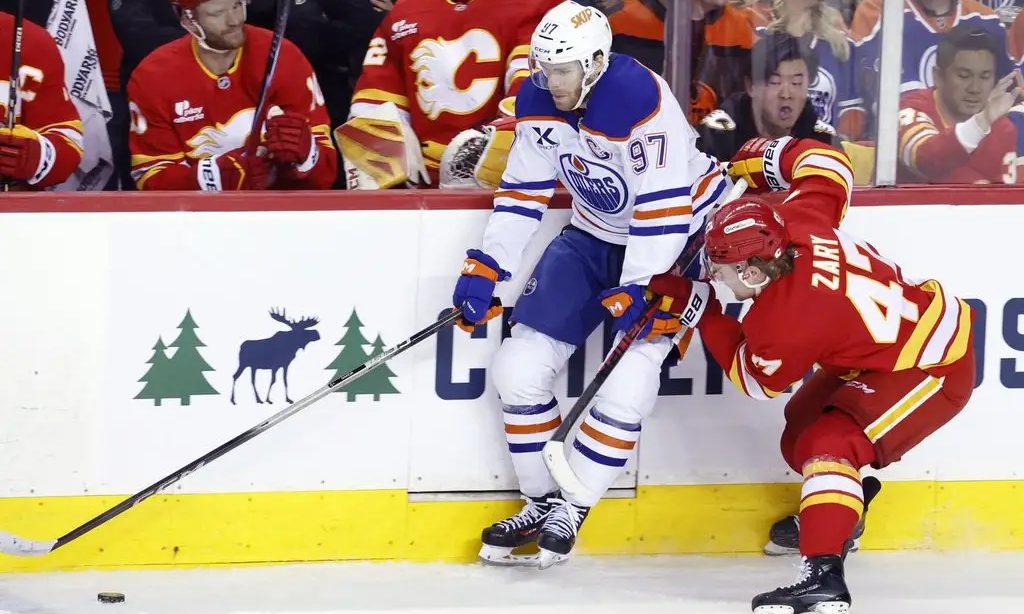
Broadcasters and Provincial Time Shifts Force Late Puck Drops
Puck drops across Western Canada are seeing unprecedented variation this season following decisions by Alberta, British Columbia, and Manitoba to remain permanently on daylight saving time. Because the National Hockey League’s schedule is heavily shaped by broadcast rights holders, ending the seasonal clock shifts has introduced new scheduling wrinkles for teams and viewers alike.
Flames and Oilers Adjust to 9 P.M. Starts
In Alberta, the Calgary Flames will play eight games starting at 9 p.m. this season, including two home contests at the Saddledome on Dec. 26 against Vancouver and Jan. 16 against Los Angeles. Flames president and chief executive officer Robert Hayes noted that while the timing is outside the team’s control, late Saturday starts might offer a stronger party atmosphere. Calgary forward Ryan Strome mentioned his young children will be unable to attend those late contests, joking that his tickets will be free those evenings. The Flames also feature eight afternoon starts beginning at 2:30 p.m. or earlier, up from five in 2025-26.
The Edmonton Oilers face seven 9 p.m. starts of their own, featuring home matchups at Rogers Place on Nov. 7 against the Canucks and March 6 against Chicago. Oilers defenceman Jake Walman, who is originally from Toronto, remarked that family back home will likely find it difficult to stay up for those games. Edmonton forward Trent Frederic plans to modify his daily routine by taking later naps and eating lunch later to stay alert for late-night puck drops.
Changes Across Vancouver and Winnipeg Schedule
The Vancouver Canucks are dealing with unusual road start times as well, ranging from 4:45 p.m. to 7:40 p.m., along with a five-different-start-time stretch during a late-January road trip. Canucks winger Brendan Gallagher acknowledged the setup is unprecedented, though he expects players to adjust their routines once games get underway.
Meanwhile, after Manitoba declared its switch to permanent daylight time on Sept. 17, the NHL pushed back 12 Winnipeg Jets home games by an hour, though none will start later than 7:30 p.m. local time. Jets supporters will still encounter late road starts, including a 9:30 p.m. start in Utah on Dec. 2 and a 10 p.m. game in Vancouver on Feb. 13.
SPORTS
Newcomer Paul Cotter Delivers Overtime Thriller in Canucks’ Season Opener
Paul Cotter scored twice, including the overtime winner, to lead the Vancouver Canucks past the Edmonton Oilers 6-5 in their NHL season opener.

Cotter Seals Victory in Extra Time
Vancouver newcomer Paul Cotter scored 1:58 into 3-on-3 overtime to cap off a wild 6-5 victory against the Edmonton Oilers on Tuesday night at Rogers Place. Cotter grabbed a pass from Max Sasson following strong forechecking to backhand the game-winning goal past Oilers goaltender Tristan Jarry. Cotter also opened the scoring for Vancouver with a first-period shorthanded tally on a 2-on-1 break alongside Arshdeep Bains.
High-Scoring Battle in Edmonton
The season-opening clash featured debuting head coaches Manny Malhotra for Vancouver and Mike Babcock for Edmonton. The Canucks built a 5-2 lead early in the third period thanks to goals from Marco Rossi, Jonathan Lekkerimaki, Sasson, and Elias Pettersson. Edmonton mounted a fierce comeback late in regulation, aided by a hat trick and two assists from blue-liner Evan Bouchard, along with two goals from former Canuck Vasily Podkolzin. Podkolzin tied the game 5-5 with just 41.8 seconds remaining on a 6-on-4 power play with Jarry pulled.
Game Notes and Next Matchup
Vancouver netminder Kevin Lankinen made 30 saves on 35 shots to secure the victory, while Edmonton outshot the visitors 36-21 overall. The Canucks played without injured regulars Thatcher Demko and Filip Chytil, while forward Brendan Gallagher made his team debut. Vancouver converted 1-of-2 power plays compared to Edmonton’s 1-of-4 performance. Both clubs face each other again Thursday at 7 p.m. in Vancouver.
SPORTS
BC Lions Hold Off Toronto Argonauts Behind Sean Whyte’s Record Eight Field Goals
Sean Whyte kicks a club-record eight field goals as the B.C. Lions defeat the Toronto Argonauts 24-17 after a dramatic late goal-line stand at BMO Field.

Whyte Sets Club Mark in Thrilling Road Victory
Sean Whyte booted a franchise-record eight field goals on Saturday afternoon, leading the B.C. Lions to a 24-17 victory against the Toronto Argonauts at BMO Field. The win marks B.C.’s third consecutive victory and seventh in eight games, solidifying their position for second place in the West Division.
Whyte surpassed the previous club record he co-held with Lui Passaglia. Edmonton’s Vincent Blanchard holds the CFL single-game record with nine field goals, set on Sept. 26. The loss ended Toronto’s four-game winning streak and marked their first defeat at home in five games.
Late Goal-Line Stand Preserves B.C. Victory
Toronto had a chance to tie the game late in the fourth quarter, but B.C.’s defence halted Toronto quarterback Nick Arbuckle twice at the one-yard line, including a final stop with 11 seconds left on the clock. T.J. Lee also intercepted Arbuckle at the Lions’ 11-yard line with 2:38 remaining to choke off a separate drive.
Arbuckle finished the afternoon completing 27 of 33 passes for 292 yards, two touchdowns, and two interceptions. B.C. starter Nathan Rourke completed 15 of 32 pass attempts for 254 yards in front of 13,974 fans.
How the Scoring Unfolded
Whyte opened the game with a 39-yard field goal, followed by connections from 26 and 32 yards out. Toronto responded with a five-yard touchdown catch by Makai Polk to take a 10-9 lead late in the second quarter. However, a 12-yard kick by Whyte with one second left on the clock sent B.C. into halftime with a 12-10 advantage.
In the second half, Whyte added field goals from 19, 40, and 29 yards out before Arbuckle connected with David Ungerer on a 36-yard touchdown pass to close the gap to 21-17. Whyte capped the scoring with his eighth field goal to secure the final seven-point margin.

Where Provincial Jobless Rates Stood in September
What New Brunswick’s Latest Unemployment Figures Mean for Your Community

Who Is Running in Your Riding for the 2026 BC Election?

How Central Okanagan Residents Can Avoid Costly Household Plumbing Damage This Thanksgiving

BC Supreme Court Judge Set to Rule on Sentence Length for Former Gang Member

Loss of Newborn Calf Puts Fresh Focus on Endangered Southern Resident Whales

Opinion: John Rustad Has to Go

B.C. Supreme Court Grants Cowichan Tribes Title to Historic Richmond Lands and Fishing Rights

Vancouver Canucks Gear Up for a Make-or-Break 2025–26 Season

Province to Appeal Cowichan Tribes Land Decision

Kamloops Blazers Announce Off-Season Changes Ahead of 2025–26 Season

Kamloops Prepares Four Reverse Referendums on $188M in Major Projects
-

 LOCAL7 days ago
Have You Seen Him? Public Help Sought in Locating Missing Traveller Last Seen in Kamloops
-

 BC STORIES7 days ago
Why a Familiar Political Name is Joining the Kamloops-North Thompson Race
-
LOCAL6 days ago
Your Current 3 Day Forecast — October 4, 2026
-

 LOCAL7 days ago
Two Displaced as Investigators Eye Suspicious Four-Plex Fire in Kelowna
-

 COMMUNITY4 days ago
Why Okanagan Pet Owners Turned to Free BC SPCA Clinics After Wildfire Season
-

 OPINIONS4 days ago
B.C. Election Poll Puts Conservatives Ahead Five Points as Cost of Living Tops Voters’ Concerns
-

 BC STORIES4 days ago
B.C. Patients Could Soon Select Surgical Lists Based on Wait Times Under NDP Plan
-
LOCAL3 days ago
Your Current 3 Day Forecast — October 7, 2026