OPINIONS
Wilbur Turner Wants to Be a School Trustee. Voters Should Examine His Political Record First.


Wilbur Turner Wants to Be a School Trustee. Voters Should Examine His Political Record First.
By Chad Dashly | The Current
Wilbur Turner would like voters in Lake Country and Central Okanagan East to see him as an experienced educator, parent and community advocate seeking a seat on the School District 23 board.
That is certainly part of his record.
It is not the whole record.
Turner is also a deeply political activist who has repeatedly targeted conservative MPs, MLAs, political parties, religious figures and even members of the LGBTQ community who disagree with his positions.
There is nothing improper about political activism. Canadians have every right to criticize their elected representatives, organize petitions and advocate for causes they believe in.
But when a prominent political advocate asks voters to entrust him with the education of children, his complete public record becomes relevant.
Turner is now one of three declared candidates for the Zone I school trustee position, along with Jennifer Miles and Sean Sookochoff. According to his campaign announcement, he believes “every child deserves a strong public school system” and says he wants to give families a stronger voice. His candidacy has been officially confirmed by the District of Lake Country.
Those are admirable words.
The question is whether Turner’s history demonstrates the temperament required to represent all families—including conservative, Christian and traditional families who may not share his political worldview.
The campaign to exclude Tracy Gray
One of Turner’s highest-profile political interventions came in 2021 after then-Conservative MP Tracy Gray voted against a federal bill dealing with conversion therapy.
Turner helped lead a task force that recommended Gray be told she was not welcome at Kelowna Pride events. The recommendation followed a town hall attended by approximately 350 people, according to Castanet.
Turner and others were entitled to condemn Gray’s vote. They were entitled to organize, protest and demand an explanation.
But attempting to exclude an elected representative from a major community celebration raised a different issue.
Was the goal engagement—or punishment?
Gray represented thousands of LGBTQ residents as well as thousands of religious and socially conservative constituents. A Pride organization could have invited her to attend, placed difficult questions before her and insisted she explain her position publicly.
Instead, Turner supported telling an elected MP that she was not welcome.
That is not bridge-building. It is political gatekeeping.
It also sits awkwardly beside Turner’s current message that voters deserve “real choice.” Choice cannot simply mean a choice between candidates who already agree with the activist establishment.
From criticizing an MLA to trying to remove her
Turner’s political activism escalated when he became an organizer of the campaign to recall Kelowna-Lake Country-Coldstream MLA Tara Armstrong.
Armstrong has made a series of statements and introduced legislation that attracted intense criticism. That includes bills relating to gender-transition treatments for minors and an unsuccessful proposal to repeal British Columbia’s Human Rights Code.
Those proposals deserved vigorous examination.
Turner, however, did not stop at arguing against Armstrong. He helped organize a campaign intended to remove her from office before the next general election.
The recall effort was announced within little more than a year of Armstrong’s election. Turner described her policies as “divisive and destructive,” while organizers began recruiting the considerable number of volunteers required to gather signatures from 40 per cent of eligible voters in the riding. The campaign and its timing were documented by Castanet and other regional news organizations.
Recall is a lawful democratic mechanism. Using it is not misconduct.
But voters should still consider the threshold Turner appears to apply. Is recall reserved for corruption, serious wrongdoing or a complete abandonment of public duty? Or should it be used against politicians whose ideas an activist considers unacceptable?
Armstrong’s policies were controversial, but they were hardly concealed from voters. She was elected as a socially conservative candidate in a conservative-leaning riding. Her constituents were capable of judging her record at the next election.
Turner’s campaign effectively argued that they should not have to wait.
Pressure campaigns and cancelled events
Turner was also a vocal opponent of American worship leader and political activist Sean Feucht holding events on publicly owned Canadian property.
Feucht has made provocative and offensive statements about LGBTQ people. Turner understandably argued that this rhetoric contributes to stigma and can harm vulnerable young people.
But the controversy was never limited to whether Feucht’s opinions were offensive. It became a dispute about whether public facilities should host a lawful religious gathering at all.
After venues declined or cancelled events, Turner defended the community pressure that contributed to those decisions. He has argued that opposing extremist rhetoric is a necessary form of civic participation. The Tyee reported his concern that complacency allows hateful ideas to grow.
Turner has every right to protest Feucht.
But defenders of civil liberty also had legitimate grounds to worry about governments or publicly funded facilities deciding which lawful religious or political messages may be heard.
Free expression is easiest to defend when the speaker is polite, fashionable and popular. The real test comes when the speaker is objectionable.
A future school trustee will encounter parents, students and employees with profoundly different religious, political and moral convictions. The job is not to eliminate those disagreements. It is to manage them fairly and within the law.
A columnist who regularly puts opponents in the dock
Turner’s political commentary offers further insight into how he approaches disagreement.
In his columns, Turner has attacked Dallas Brodie, Tara Armstrong, OneBC, Pierre Poilievre and other conservative politicians. He has described OneBC’s politics as a campaign of “fear and resentment” and accused the party of building resentment against immigrants, Indigenous communities, educators, and queer and transgender people.
In a 2025 Tyee column, Turner called OneBC’s approach “the classic populist playbook” and said its rhetoric represented a danger to democracy.
In another column, he declared that white supremacy had established a place in British Columbia politics. Elsewhere, he characterized federal Conservative policies as culture-war politics that would fail when confronted by the Charter, the courts or serious financial analysis.
Turner has also criticized Conservative politicians who defended Christian expression in public spaces. When Kelowna-Centre MLA Kristina Loewen objected to wording placed near the city’s nativity display, Turner called her response divisive and “far-fetched,” according to Global News.
Any one of those criticisms can be defended as political opinion.
Taken together, however, they reveal a consistent pattern: Turner does not merely disagree with political opponents. He frequently places them within a moral framework in which their words are treated as threats, their motives are suspect and their participation may be considered harmful.
That posture works well for an activist and opinion columnist. It can mobilize supporters, generate media attention and draw sharp lines between allies and adversaries.
It is far more troubling in a school trustee.
The contradiction at the centre of Turner’s candidacy
Turner says he wants to represent families and provide voters with a meaningful choice.
But which families?
Would parents who question aspects of SOGI programming receive a fair hearing, or would they be dismissed as participants in a campaign of fear and resentment?
Would religious parents who object to particular classroom materials be treated respectfully, or associated with the rhetoric of American Christian nationalism?
Would teachers with conventional political views feel comfortable disagreeing with him publicly?
Would transgender students be protected from harassment? They absolutely should be. But would female students, gay and lesbian students, religious students and politically conservative students receive the same willingness to hear their concerns?
These are not hypothetical distractions. They go directly to the role of a trustee.
School boards must oversee budgets, facilities, transportation, enrolment growth, special education, academic achievement, student safety and relationships with parents. Trustees must make decisions affecting families whose beliefs stretch across the entire political spectrum.
That requires patience, restraint and the ability to distinguish disagreement from hatred.
Turner’s advocacy record demonstrates passion. It demonstrates persistence. It demonstrates his willingness to confront people he believes are causing harm.
What it does not consistently demonstrate is an instinct for pluralism.
Advocacy is not governance
The strongest advocates are not always the best governors.
An advocate chooses a cause and advances it relentlessly. A trustee must weigh competing rights, incomplete information, limited resources and the legitimate concerns of people with whom he disagrees.
Turner should not be attacked for being gay, for defending transgender people or for advocating for vulnerable youth. Those are not controversies, and they are not disqualifications.
The legitimate concern is political conduct.
He supported excluding an elected MP from Pride events. He organized an effort to recall an MLA whose positions he opposed. He participated in campaigns intended to deny controversial speakers access to public venues. He has repeatedly used his media platform to portray conservative politicians and organizations as dangerous, extremist or morally compromised.
Now he is asking to oversee a public education system that belongs equally to the people he has spent years denouncing.
Turner may argue that his activism proves he has the courage to protect students. His opponents may argue it shows he brings too much ideology and confrontation to a position that requires balance.
That is the debate Lake Country voters should have.
This election should not be about Turner’s identity. It should not be about denying the valuable community work he has performed. Nor should it descend into the personal hostility that has already poisoned too much of Canadian politics.
It should be about judgment.
Wilbur Turner has built a public career by challenging, condemning and organizing against those with whom he disagrees. He is entitled to that record.
Voters are equally entitled to examine it before deciding whether he is the person they want governing their schools.
Chad Dashly is an opinion columnist with The Current. The views expressed are those of the author.


Opinion | Doerkson has his majority. Now B.C. needs to see his plan.
By Chad Dashly | The Current | November 19, 2026
In Victoria, 63 Conservative MLAs are scheduled to take the oath of office Thursday. In Kelowna Centre, 43 votes separate the two candidates, and the incumbent will have to wait. Both are part of the same transfer of power. British Columbians made a clear choice about who should govern, and two communities are still waiting for the courts to confirm who will represent them.
On Friday, Lieutenant Governor Wendy Cocchia is scheduled to swear in Lorne Doerkson as B.C.’s 38th premier at Government House, where his cabinet will also be sworn in. Doerkson took over as interim Conservative leader just days before David Eby called the snap election. Eby said he needed a stronger mandate to respond to U.S. tariffs. Voters gave that mandate to the Conservatives, and Eby resigned as NDP leader after the Oct. 24 vote. Nine years of NDP government are coming to an end.
Two ridings are still waiting
Elections BC’s final count put the Conservatives at 64 seats, the NDP at 27 and the Greens at two. Those totals include the candidates leading in two ridings that are subject to automatic judicial recounts. That’s why 63 Conservatives are scheduled to take the oath Thursday. Elections BC
-
Kelowna Centre. Conservative incumbent Kristina Loewen finished 43 votes ahead of New Democrat Loyal Wooldridge. Loewen is expected to attend Thursday’s ceremony, with her oath deferred pending the recount scheduled for Monday, Nov. 23.
-
Ladysmith–Oceanside. NDP incumbent Stephanie Higginson finished 50 votes ahead of Conservative Kris McNichol. Higginson’s swearing-in depends on the recount and certification of the result. The NDP caucus ceremony is scheduled for Thursday, Nov. 26. Green MLAs Emily Lowan and Jeremy Valeriote are scheduled to take their oaths Monday, Nov. 23.
Both recounts are required because the margin was less than one five-hundredth of the ballots considered in each riding. The Conservatives have a majority whichever way those counts go. For people in Kelowna Centre and Ladysmith–Oceanside, the outcome still determines who answers their calls and speaks for them in Victoria. That matters every day between elections.
No fall sitting means fewer chances to ask hard questions
Doerkson says his ministers will get to work immediately and prepare legislation for the spring. His government has decided against a fall sitting. A new cabinet needs time to get across its files, but the decision also means opposition MLAs lose the chance to question ministers on the floor of the legislature this fall. The government can make up some of that ground by publishing ministerial mandates, setting deadlines and making ministers available to answer for their early decisions.
Start with the books. The province’s first-quarter update projected a $13.8-billion deficit for 2026–27. That figure is a forecast for one fiscal year. If the Conservatives intend to bring it down, British Columbians deserve to know what they’ll change, what services they’ll protect and how soon they expect to see results. Those answers matter to a family waiting for a doctor in the Interior and to a small manufacturer trying to decide whether it can afford to hire through tariff uncertainty.
Friday’s cabinet appointments will tell us who has been given the work. By spring, British Columbians should be able to see what each minister has done with it. Doerkson has enough seats to make decisions. He can start earning trust by showing the public how he makes them.
Save Local Journalism—Including the Voices Outside the Big Chains
By Chad Dashly | Opinion | The Current
When the big newspaper groups warn that local journalism is in trouble, we should listen.
When they ask government to help pay the bills, we should ask questions.
Both are part of a healthy democracy.
B.C.’s community newspaper industry is calling for a greater share of provincial advertising spending to stay with local publishers. Its argument deserves consideration: governments need to communicate with residents, and local news outlets need advertising revenue to keep reporting.
But there is a bigger question behind that request.
Will any new arrangement support a diverse local press, including independent digital publishers, or simply help the largest established players hold their ground?
That distinction matters to every community that wants more than one version of the story.
Journalism belongs to the community
Peter Kvarnstrom reports that Black Press community newspapers and eight Glacier publications produced more than 7,000 election stories and columns during October’s municipal and provincial campaigns. That represents substantial work by reporters helping voters understand their choices.
Those journalists deserve credit. A reporter working for a large chain can be just as committed to their community as someone working for a small independent outlet.
But the number of stories a company publishes does not give it ownership of the public interest.
Independent outlets bring additional questions, different editorial judgments and another place for residents to take concerns. Sometimes they pursue an issue others have overlooked. Sometimes they challenge a comfortable local consensus.
Readers benefit from that competition.
A town with several outlets asking questions has a better chance of getting answers than a town depending on one editorial desk.
Public advertising needs public rules
The industry’s proposal calls for at least 25 per cent of government advertising spending to go to local media. Kvarnstrom has advocated extending that approach to Crown corporations as well.
Let’s be precise: purchasing advertising is a commercial transaction. It is different from handing a newsroom an unrestricted operating grant.
Government has legitimate reasons to buy advertising. Residents need information about public services, road closures, emergency preparedness and programs their taxes support.
The test should be whether that spending reaches people effectively, delivers value and follows fair, published rules.
An independent digital publisher should have a fair opportunity to compete. So should a community newspaper, a local broadcaster or another credible outlet serving an identifiable audience.
Owning a printing press should confer no special claim on taxpayers’ money. Neither should belonging to a large publishing group.
And favourable coverage must never become an unofficial qualification.
Independence requires more than a label
Receiving government advertising does not automatically compromise a newsroom. Refusing it does not automatically make a publication trustworthy.
Independence is demonstrated through conduct: checking facts, correcting mistakes, separating advertising from editorial decisions and asking difficult questions even when the answers might upset someone who pays the bills.
That applies to governments. It also applies to private advertisers, owners and political allies.
Still, any system that puts public officials in charge of allocating revenue to the outlets covering them deserves close scrutiny.
Publish the recipients. Publish the amounts. Explain the selection criteria. Make access fair for smaller publishers.
Public confidence requires that much.
Readers and businesses have a role
Government spending alone cannot provide a durable foundation for independent journalism.
Local businesses make a choice every time they place an advertisement. Readers make one when they subscribe, contribute, share an original report or introduce a publication to a potential advertiser.
Those choices help determine which voices survive.
At The Current, we believe communities deserve reporting and commentary that earn their attention, challenge decisions and give people a reason to stay engaged.
We also believe readers should be able to compare our work with someone else’s.
So yes, take the financial crisis facing local journalism seriously.
But if government changes how it buys advertising, the objective should be a stronger, more varied local press.
The big boys deserve a fair hearing. Independent publishers deserve a fair chance. And the public deserves a press nobody can take for granted.
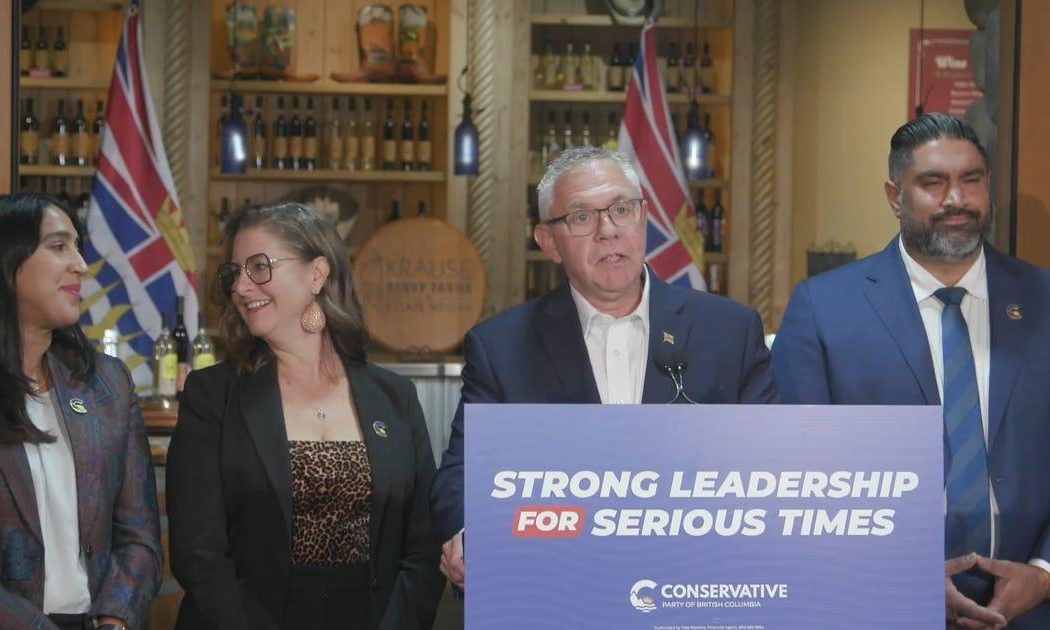
The Money Spoke Before the Voters Did: How B.C.’s Conservatives Turned Chaos Into Victory
By Chad Dashly | The Current | November 5, 2026
There is an old saying in politics: follow the money.
In British Columbia, the money was telling a story long before voters went to the polls on October 24. And if anyone at NDP headquarters was paying attention, they should have been worried.
New third-quarter fundraising figures show the Conservative Party of British Columbia raised approximately $2.73 million, compared with just $986,093 for the NDP.
Nearly three dollars for the Conservatives for every dollar raised by the New Democrats.
But the real story isn’t simply how much money came in. It’s when it arrived — and what that tells us about the extraordinary political transformation British Columbia has just experienced.
From Political Chaos to Political Capital
Only weeks before the election, the BC Conservatives appeared to be doing everything possible to destroy themselves.
Leadership disputes. Caucus defections. Public disagreements. A party seemingly more interested in fighting itself than fighting the government.
Then came September 20.
Kerry-Lynne Findlay resigned as Conservative leader, and Cariboo-Chilcotin MLA Lorne Doerkson stepped into the leadership.
What happened next should become a case study for political strategists across Canada.
Between September 20 and September 30, Conservative contributions totalled approximately $2.45 million — nearly 90 per cent of the party’s entire third-quarter fundraising.
Think about that.
A party struggling to hold itself together suddenly attracted millions of dollars in political contributions in just eleven days.
That doesn’t happen by accident.
It suggests donors who had been sitting on the sidelines were suddenly prepared to invest in a political organization they believed could win.
The change in leadership mattered. So did the prospect of an election. And the Conservatives had something they hadn’t possessed in months: a credible opportunity to unite their competing factions around a common objective.
Winning.
David Eby’s Political Miscalculation
Premier David Eby called a snap election on September 22, two years ahead of the scheduled provincial vote.
The calculation appeared straightforward.
The Conservatives were divided. Their leadership had collapsed. Their caucus had fractured. Surely this was the moment to strike.
Except something had changed.
The Conservative Party that Eby expected to face was rapidly becoming a different political organization.
Doerkson’s arrival created an opportunity for reconciliation among Conservatives who had spent months arguing about personalities, policies and direction.
And the fundraising figures suggest that opportunity resonated.
Meanwhile, the NDP struggled to generate comparable financial enthusiasm.
That is not necessarily proof that donors predicted the election result. Political contributions are influenced by many factors, including campaign timing, organizational strength and individual donor networks.
But the disparity was an unmistakable warning.
Eby may have correctly identified Conservative instability. What he appears to have underestimated was how quickly that instability could turn into unity when the prospect of forming government became real.
The Interior Has Become the Centre of Political Power
There is another dimension to this election that deserves attention.
British Columbia’s political centre of gravity has shifted.
For decades, provincial politics has been dominated by Vancouver, Victoria and the Lower Mainland.
Now a politician from the Cariboo-Chilcotin is preparing to lead the province.
That matters.
For communities throughout the Thompson, Okanagan, Cariboo and northern British Columbia, the election represents an opportunity to bring regional economic concerns directly into the premier’s office.
Forestry. Mining. Natural gas. Agriculture. Transportation infrastructure. Permitting delays.
These are not abstract policy debates for people who live and work outside the Lower Mainland.
They determine whether businesses invest, whether young families can remain in their communities and whether the next generation has meaningful economic opportunities.
Doerkson has promised to make economic development a priority.
The question now is whether his government can turn those promises into measurable results.
Money Can Win Elections. It Cannot Govern.
Conservatives should be careful about celebrating too early.
Preliminary election results give the party 63 of the legislature’s 93 seats, although the final count is still pending.
That is a commanding position.
But a large majority does not automatically produce a successful government.
The same party that recently struggled with internal divisions must now demonstrate cabinet discipline, sound fiscal management and the ability to make difficult decisions.
British Columbians will expect progress on affordability, health care, housing and economic opportunity.
They will also expect accountability.
The Conservatives have promised no new taxes, faster approvals for major projects and stronger support for resource development.
Delivering those commitments while maintaining essential public services will require more than campaign slogans.
It will require serious governing.
The Lesson for Every Political Party
The fundraising numbers reveal something larger than a financial advantage.
They suggest a dramatic change in political confidence.
Donors were willing to back the Conservatives despite the party’s recent turmoil. Voters subsequently handed them a decisive preliminary victory.
For the NDP, the implications are equally significant.
A party that controlled the government machinery and chose the election date was unable to match its opponent’s fundraising momentum.
That demands more than a routine campaign review.
It demands an examination of leadership, organization, voter relationships and the party’s understanding of the province’s changing political priorities.
For the Conservatives, the challenge is different.
They have won the opportunity to govern. Now they must prove they deserve to keep it.
The money may have spoken before the voters did. But from this point forward, British Columbians will judge their new government not by what it raised, but by what it delivers.
Chad Dashly writes political commentary for The Current, examining British Columbia politics, public policy and the decisions shaping communities across the province.
Your Current 3 Day Forecast — November 22, 2026
Your Current 3 Day Forecast — November 21, 2026

B.C. Lawmaker Urges New Premier to Retain AI Lawsuit After Latest ChatGPT Revelations

BC Conservatives Assign Key Legislative Roles Following Cabinet Selection

What B.C.’s New Conservative Government and Cabinet Mean for You
Your Current 3 Day Forecast — November 20, 2026

Opinion: John Rustad Has to Go

B.C. Supreme Court Grants Cowichan Tribes Title to Historic Richmond Lands and Fishing Rights

Vancouver Canucks Gear Up for a Make-or-Break 2025–26 Season

Province to Appeal Cowichan Tribes Land Decision

Kamloops Blazers Announce Off-Season Changes Ahead of 2025–26 Season

Kamloops Prepares Four Reverse Referendums on $188M in Major Projects
-

 COMMUNITY6 days ago
Why Cannonball-Shaped Volcanic Rocks Cover the Cliffs of Summerland
-

 NATIONAL STORIES6 days ago
House Unanimously Approves Bill Giving Young Offenders Access to Addiction Treatment
-
NATIONAL STORIES6 days ago
How October Inflation Rates Shifted Across Canadian Provinces
-

 NATIONAL STORIES6 days ago
How a Fake Invoice Cost a Shuswap Business Over $24,000
-
SPORTS6 days ago
Inside Toronto’s Royal Rodeo, Young Riders Show Grit in Rough-Stock Events
-

 LOCAL6 days ago
Clearance Underway After Sunday Afternoon Crash Near University Way Stalls Highway 97 Traffic
-

 COMMUNITY6 days ago
Inside the Busy Life of a 25-Year-Old Strategist Shaping North Okanagan Politics
-

 BC STORIES5 days ago
Why Telus Is Walking Away From High-Profile Vancouver AI Projects