SPORTS
Major Blow for Pittsburgh: Sidney Crosby Sidelined for Four Weeks Following Olympic Injury
Pittsburgh Penguins captain Sidney Crosby is sidelined for four weeks after a lower-body injury at the Olympics. Read the full analysis of the NHL impact.


The Immediate Impact of Crosby’s Absence
The Pittsburgh Penguins’ aspirations for the remainder of the regular season have hit a significant hurdle. Captain Sidney Crosby, the centerpiece of the franchise for nearly two decades, is expected to be sidelined for a minimum of four weeks following a lower-body injury. The injury occurred while Crosby was competing for Team Canada on the international stage during the Olympics, a development that reignites the long-standing debate regarding NHL participation in mid-season tournaments. While the specific nature of the injury remains undisclosed per team policy, the timeline suggests a recovery period that will see Crosby miss critical divisional matchups. For a team currently battling for playoff positioning in the highly competitive Metropolitan Division, the loss of their leading scorer and emotional leader creates an immediate void that cannot be easily filled by a single player. The Penguins medical staff confirmed the diagnosis following a series of evaluations conducted upon Crosby’s return to Pittsburgh, marking a somber start to the season’s final stretch.
Next Man Up: Reshuffling the Penguins Lineup
Head coach Mike Sullivan now faces the daunting task of reconfiguring his top six forwards without his primary engine. Historically, the Penguins have relied on Evgeni Malkin to shoulder the offensive burden whenever Crosby is absent. Malkin, a former Hart Trophy winner, has often performed at an elite level when shifted into the primary center role, but the ripple effect through the lineup is substantial. The second and third lines will require significant adjustments, likely pulling from the team’s depth in their AHL affiliate or asking veteran wingers to take on more defensive responsibility. The power play, which revolves around Crosby’s vision from the half-wall and his unmatched ability to protect the puck behind the net, will also undergo a transformation. Without the “Sidney Crosby effect,” the Penguins must find new ways to penetrate structured penalty kills. Defenseman Kris Letang will likely see increased minutes as the primary puck-mover, but the lack of Crosby’s elite board-play and faceoff dominance will be felt in every zone of the ice. Sullivan noted in a press conference that while no one can replace Sid, the team has a history of resilience in the face of adversity.
The Olympic Risk-Reward Calculation
Crosby’s injury serves as a cautionary tale for NHL owners and general managers who have often been wary of releasing their multi-million dollar assets for international play. While representing one’s country is the pinnacle of athletic achievement for many players, the physical toll of an Olympic schedule—characterized by high-intensity games and grueling travel—often leads to attrition. For Team Canada, Crosby is a talismanic figure who has delivered multiple gold medals, but for the Pittsburgh Penguins, he is the heart of their business and competitive success. This incident is expected to be a major talking point in future Collective Bargaining Agreement negotiations between the league and the Players’ Association. While fans clamor for “best-on-best” hockey, the reality of a star player returning from the Games in a walking boot or on crutches remains the ultimate nightmare for front offices. The debate will likely intensify as the league weighs the marketing benefits of global exposure against the tangible risk of losing franchise icons during the most critical part of the NHL calendar.
Playoff Implications and the Road Ahead
Looking at the calendar, a four-week recovery timeline puts Crosby’s return just ahead of the final push toward the Stanley Cup Playoffs. If the recovery goes according to plan, he should have enough time to regain his game conditioning before the postseason begins. However, the danger lies in the Penguins sliding down the standings in the interim. A poor four-week stretch could mean the difference between home-ice advantage and a difficult first-round matchup against a top-seeded opponent or, in the worst-case scenario, falling out of a playoff spot entirely. The Metropolitan Division remains a gauntlet, with teams like the Hurricanes and Rangers surging. The Penguins will need a collective effort from their bottom-six forwards and a stellar performance from their goaltending to weather the storm. Crosby’s absence also puts a spotlight on the team’s leadership group; players like Bryan Rust and Jake Guentzel will need to elevate their scoring pace to compensate for the missing production. As one of the most dedicated athletes in professional sports, Crosby is known for his rigorous approach to fitness and recovery. The hockey world will be watching closely as Pittsburgh attempts to stay afloat without their legendary number 87, hoping that the captain’s return coincides with a team that has found its grit in his absence.

SPORTS
Why West Coast NHL Fans and Players Will Face Unusual Game Times This Season
Permanent daylight time in Alberta, B.C., and Manitoba has forced the NHL to shuffle start times, creating 9 p.m. puck drops for Western Canadian teams.

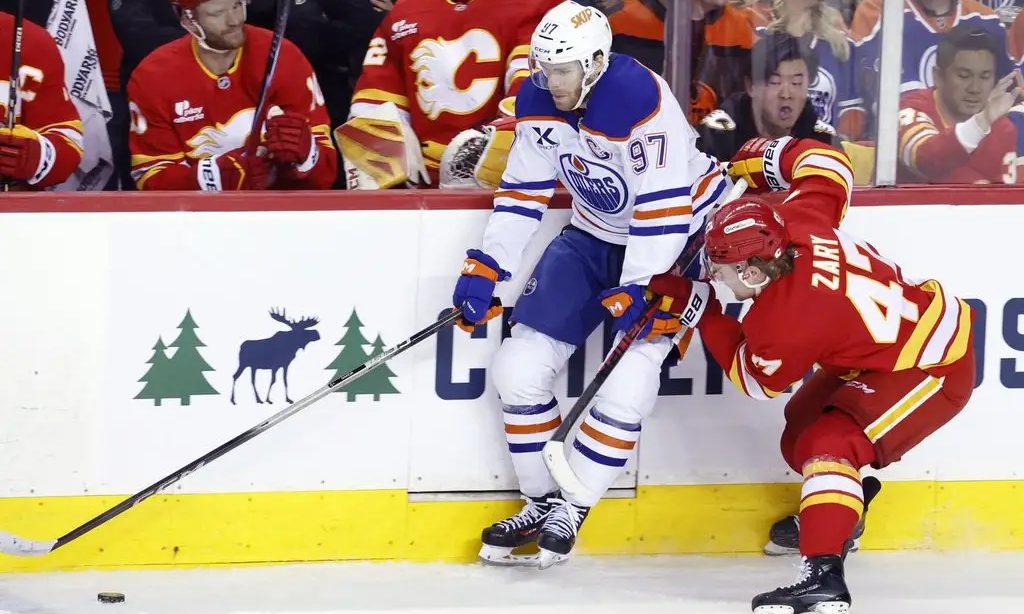
Broadcasters and Provincial Time Shifts Force Late Puck Drops
Puck drops across Western Canada are seeing unprecedented variation this season following decisions by Alberta, British Columbia, and Manitoba to remain permanently on daylight saving time. Because the National Hockey League’s schedule is heavily shaped by broadcast rights holders, ending the seasonal clock shifts has introduced new scheduling wrinkles for teams and viewers alike.
Flames and Oilers Adjust to 9 P.M. Starts
In Alberta, the Calgary Flames will play eight games starting at 9 p.m. this season, including two home contests at the Saddledome on Dec. 26 against Vancouver and Jan. 16 against Los Angeles. Flames president and chief executive officer Robert Hayes noted that while the timing is outside the team’s control, late Saturday starts might offer a stronger party atmosphere. Calgary forward Ryan Strome mentioned his young children will be unable to attend those late contests, joking that his tickets will be free those evenings. The Flames also feature eight afternoon starts beginning at 2:30 p.m. or earlier, up from five in 2025-26.
The Edmonton Oilers face seven 9 p.m. starts of their own, featuring home matchups at Rogers Place on Nov. 7 against the Canucks and March 6 against Chicago. Oilers defenceman Jake Walman, who is originally from Toronto, remarked that family back home will likely find it difficult to stay up for those games. Edmonton forward Trent Frederic plans to modify his daily routine by taking later naps and eating lunch later to stay alert for late-night puck drops.
Changes Across Vancouver and Winnipeg Schedule
The Vancouver Canucks are dealing with unusual road start times as well, ranging from 4:45 p.m. to 7:40 p.m., along with a five-different-start-time stretch during a late-January road trip. Canucks winger Brendan Gallagher acknowledged the setup is unprecedented, though he expects players to adjust their routines once games get underway.
Meanwhile, after Manitoba declared its switch to permanent daylight time on Sept. 17, the NHL pushed back 12 Winnipeg Jets home games by an hour, though none will start later than 7:30 p.m. local time. Jets supporters will still encounter late road starts, including a 9:30 p.m. start in Utah on Dec. 2 and a 10 p.m. game in Vancouver on Feb. 13.
SPORTS
Newcomer Paul Cotter Delivers Overtime Thriller in Canucks’ Season Opener
Paul Cotter scored twice, including the overtime winner, to lead the Vancouver Canucks past the Edmonton Oilers 6-5 in their NHL season opener.

Cotter Seals Victory in Extra Time
Vancouver newcomer Paul Cotter scored 1:58 into 3-on-3 overtime to cap off a wild 6-5 victory against the Edmonton Oilers on Tuesday night at Rogers Place. Cotter grabbed a pass from Max Sasson following strong forechecking to backhand the game-winning goal past Oilers goaltender Tristan Jarry. Cotter also opened the scoring for Vancouver with a first-period shorthanded tally on a 2-on-1 break alongside Arshdeep Bains.
High-Scoring Battle in Edmonton
The season-opening clash featured debuting head coaches Manny Malhotra for Vancouver and Mike Babcock for Edmonton. The Canucks built a 5-2 lead early in the third period thanks to goals from Marco Rossi, Jonathan Lekkerimaki, Sasson, and Elias Pettersson. Edmonton mounted a fierce comeback late in regulation, aided by a hat trick and two assists from blue-liner Evan Bouchard, along with two goals from former Canuck Vasily Podkolzin. Podkolzin tied the game 5-5 with just 41.8 seconds remaining on a 6-on-4 power play with Jarry pulled.
Game Notes and Next Matchup
Vancouver netminder Kevin Lankinen made 30 saves on 35 shots to secure the victory, while Edmonton outshot the visitors 36-21 overall. The Canucks played without injured regulars Thatcher Demko and Filip Chytil, while forward Brendan Gallagher made his team debut. Vancouver converted 1-of-2 power plays compared to Edmonton’s 1-of-4 performance. Both clubs face each other again Thursday at 7 p.m. in Vancouver.
SPORTS
BC Lions Hold Off Toronto Argonauts Behind Sean Whyte’s Record Eight Field Goals
Sean Whyte kicks a club-record eight field goals as the B.C. Lions defeat the Toronto Argonauts 24-17 after a dramatic late goal-line stand at BMO Field.

Whyte Sets Club Mark in Thrilling Road Victory
Sean Whyte booted a franchise-record eight field goals on Saturday afternoon, leading the B.C. Lions to a 24-17 victory against the Toronto Argonauts at BMO Field. The win marks B.C.’s third consecutive victory and seventh in eight games, solidifying their position for second place in the West Division.
Whyte surpassed the previous club record he co-held with Lui Passaglia. Edmonton’s Vincent Blanchard holds the CFL single-game record with nine field goals, set on Sept. 26. The loss ended Toronto’s four-game winning streak and marked their first defeat at home in five games.
Late Goal-Line Stand Preserves B.C. Victory
Toronto had a chance to tie the game late in the fourth quarter, but B.C.’s defence halted Toronto quarterback Nick Arbuckle twice at the one-yard line, including a final stop with 11 seconds left on the clock. T.J. Lee also intercepted Arbuckle at the Lions’ 11-yard line with 2:38 remaining to choke off a separate drive.
Arbuckle finished the afternoon completing 27 of 33 passes for 292 yards, two touchdowns, and two interceptions. B.C. starter Nathan Rourke completed 15 of 32 pass attempts for 254 yards in front of 13,974 fans.
How the Scoring Unfolded
Whyte opened the game with a 39-yard field goal, followed by connections from 26 and 32 yards out. Toronto responded with a five-yard touchdown catch by Makai Polk to take a 10-9 lead late in the second quarter. However, a 12-yard kick by Whyte with one second left on the clock sent B.C. into halftime with a 12-10 advantage.
In the second half, Whyte added field goals from 19, 40, and 29 yards out before Arbuckle connected with David Ungerer on a 36-yard touchdown pass to close the gap to 21-17. Whyte capped the scoring with his eighth field goal to secure the final seven-point margin.

Where Provincial Jobless Rates Stood in September
What New Brunswick’s Latest Unemployment Figures Mean for Your Community

Who Is Running in Your Riding for the 2026 BC Election?

How Central Okanagan Residents Can Avoid Costly Household Plumbing Damage This Thanksgiving

BC Supreme Court Judge Set to Rule on Sentence Length for Former Gang Member

Loss of Newborn Calf Puts Fresh Focus on Endangered Southern Resident Whales

Opinion: John Rustad Has to Go

B.C. Supreme Court Grants Cowichan Tribes Title to Historic Richmond Lands and Fishing Rights

Vancouver Canucks Gear Up for a Make-or-Break 2025–26 Season

Province to Appeal Cowichan Tribes Land Decision

Kamloops Blazers Announce Off-Season Changes Ahead of 2025–26 Season

Kamloops Prepares Four Reverse Referendums on $188M in Major Projects
-

 LOCAL7 days ago
Have You Seen Him? Public Help Sought in Locating Missing Traveller Last Seen in Kamloops
-

 BC STORIES7 days ago
Why a Familiar Political Name is Joining the Kamloops-North Thompson Race
-
LOCAL6 days ago
Your Current 3 Day Forecast — October 4, 2026
-

 LOCAL7 days ago
Two Displaced as Investigators Eye Suspicious Four-Plex Fire in Kelowna
-

 COMMUNITY4 days ago
Why Okanagan Pet Owners Turned to Free BC SPCA Clinics After Wildfire Season
-

 OPINIONS4 days ago
B.C. Election Poll Puts Conservatives Ahead Five Points as Cost of Living Tops Voters’ Concerns
-

 BC STORIES4 days ago
B.C. Patients Could Soon Select Surgical Lists Based on Wait Times Under NDP Plan
-

 SPORTS5 days ago
BC Lions Hold Off Toronto Argonauts Behind Sean Whyte’s Record Eight Field Goals