OPINIONS
OPINION: A Vision for Canada: Building Bold, Building Now


Canada stands at a pivotal moment. Recent policy shifts, driven by growing trade tensions, economic slowdowns, and a global race for critical resources have illuminated a stark truth: infrastructure is our lifeline to resilience and prosperity. The One Canadian Economy Act and Building Canada Act, paired with a newly established Major Projects Office in Calgary, aim to cut red tape and prioritize “national interest” projects. These are ambitious steps toward unlocking Canada’s potential
Action can’t wait. Investments are flowing: over $18 million is heading to Yukon communities for core upgrades through the Canada Community-Building Fund in urban transit, Montreal’s $6.5 billion REM light metro expands rapidly toward full deployment and Alto, the proposed high-speed rail linking Toronto and Quebec City, promises to transform national mobility. These projects reflect ideas, not inertia, however much more is needed.
Why Canada Must Think Big—and Build Bigger
Economic Diversification and Global Competitiveness
The post-pandemic and protectionist trade environment has shown that relying on a narrow economic model leaves Canada vulnerable. Building infrastructure, from energy and transit to ports and corridors, can diversify our trade, reduce dependence, and address major bottlenecks. The proposed Ontario-Alberta energy corridor (including deep-sea ports and pipelines) exemplifies how infrastructure can strengthen inter-provincial cohesion and energy trade.
Unlocking the Critical Minerals Economy
Canada’s vast reserves of rare earths and strategic minerals are largely unexploited due to weak processing infrastructure and funding gaps. While the government has backed projects like Strange Lake, industry leaders warn that without faster approvals and investment, Canada cannot realistically challenge China’s 90% hold over minerals processing. Streamlined infrastructure investment is foundational to building those new supply chains.
Building with Inclusivity and Speed
The Building Canada Act’s requirement to consult and partner with Indigenous communities recognizes that this development must be done in partnership with Canada’s First Nations.Infrastructure banks, like the Canada Infrastructure Bank, can accelerate progress by enabling public-private models that deliver faster results.
The clock is ticking. Canadians don’t just need infrastructure, we need infrastructure that embodies a national mission: diversifying our economy, building modern supply lines, and moving swiftly to prepare for a challenging future. To do that, we must embrace both ambition and pragmatism. There is a blueprint but we need to act on it.
We can’t keep planning in slow motion. The time to build is now. Let’s push Canada’s infrastructure into the 21st century. Not one project at a time, but with bold ambition and unity of purpose.




OPINIONS
B.C. Election Poll Puts Conservatives Ahead Five Points as Cost of Living Tops Voters’ Concerns


The BC Conservatives lead the BC NDP 48% to 43% among decided and leaning voters in a new Angus Reid Institute poll. Cost of living is the top concern, named by 57% of respondents, followed by health care at 42%.
By Chad Dashly | The Current
A new Angus Reid Institute poll puts the BC Conservatives five points ahead of the BC NDP, but the closer look is more complicated than the topline suggests: both parties have gained support, voters are beginning to settle on their choices, and the issues they want leaders to address are firmly rooted at home.
The online survey, conducted October 1–3, found that 48% of decided and leaning voters would support the BC Conservatives, compared with 43% for the BC NDP. The poll was released after the nomination deadline finalized most parties’ candidate slates.
The Institute says both major parties gained support during the early campaign. It attributes Conservative gains in part to a smaller pool of CentreBC and OneBC candidates competing across the province, while the NDP appears to be drawing support from the Greens. Those are the pollster’s explanations for the shifts; the results do not establish why individual voters changed their minds.
The survey also found a more settled electorate. Nearly half of respondents, 46%, said they were “very certain” of their vote, up from 35% in the first week of the campaign. That confidence is not evenly distributed: among Conservative supporters, the share who were very certain rose from 47% on September 24 to 65%. Among NDP supporters, it reached 44%, a three-point increase from the campaign’s opening week.
The poll’s issue findings are just as notable. Cost of living and inflation were the leading concerns, selected by 57% of respondents. Health care followed at 42%. The economy and jobs, housing affordability, the provincial deficit and public safety each registered at 24% to 26%.
U.S. tariffs, Donald Trump and the alcohol ban were named as a top voting issue by 10%, down from 15% in the September 22–24 survey. The Institute’s question allowed respondents to choose up to three issues. The numbers suggest that, for many voters, the cost of daily life and access to care are more immediate concerns than the cross-border dispute that featured prominently in the NDP’s case for an election.
What the poll means
The five-point Conservative lead is a snapshot, not a prediction of the final result. The vote-intention figure is based on 846 decided and leaning voters, while the wider survey included 1,013 B.C. adults. Angus Reid says the overall results were weighted to represent the province’s adult population. Its stated margin of error—plus or minus three percentage points, 19 times out of 20—applies to a probability sample of that size; this was an online panel survey, so that comparison should be treated as a guide rather than a guarantee of precision.
The more useful campaign signal may be the contrast between the two parties’ apparent momentum and the issues voters are naming. The Conservatives lead, and their supporters report a marked increase in certainty. But the NDP has also gained ground, and nearly half of respondents still do not describe themselves as very certain. There is room for the race to move.
The issue rankings also set a practical test for both leaders. Voters are pointing to affordability and health care. Broad arguments about leadership, campaign tactics or national politics may draw attention, but parties still have to show how their plans would affect household costs and people’s ability to get care.
In the poll’s results, Conservative leader Lorne Doerkson holds a narrow edge over David Eby on who would make the best premier: 36% choose Doerkson and 33% Eby. Nearly as many, 31%, choose neither. That last figure is a reminder that a lead between party options does not automatically translate into broad enthusiasm for either leader.
As the campaign advances, the question is whether the parties can turn their current support into votes—and persuade uncertain voters that their promises answer the concerns showing up most clearly in the polling.
Source: Angus Reid Institute online survey conducted October 1–3, 2026, among 1,013 B.C. adults. Vote intention is based on 846 decided and leaning voters. Read the poll and methodology.
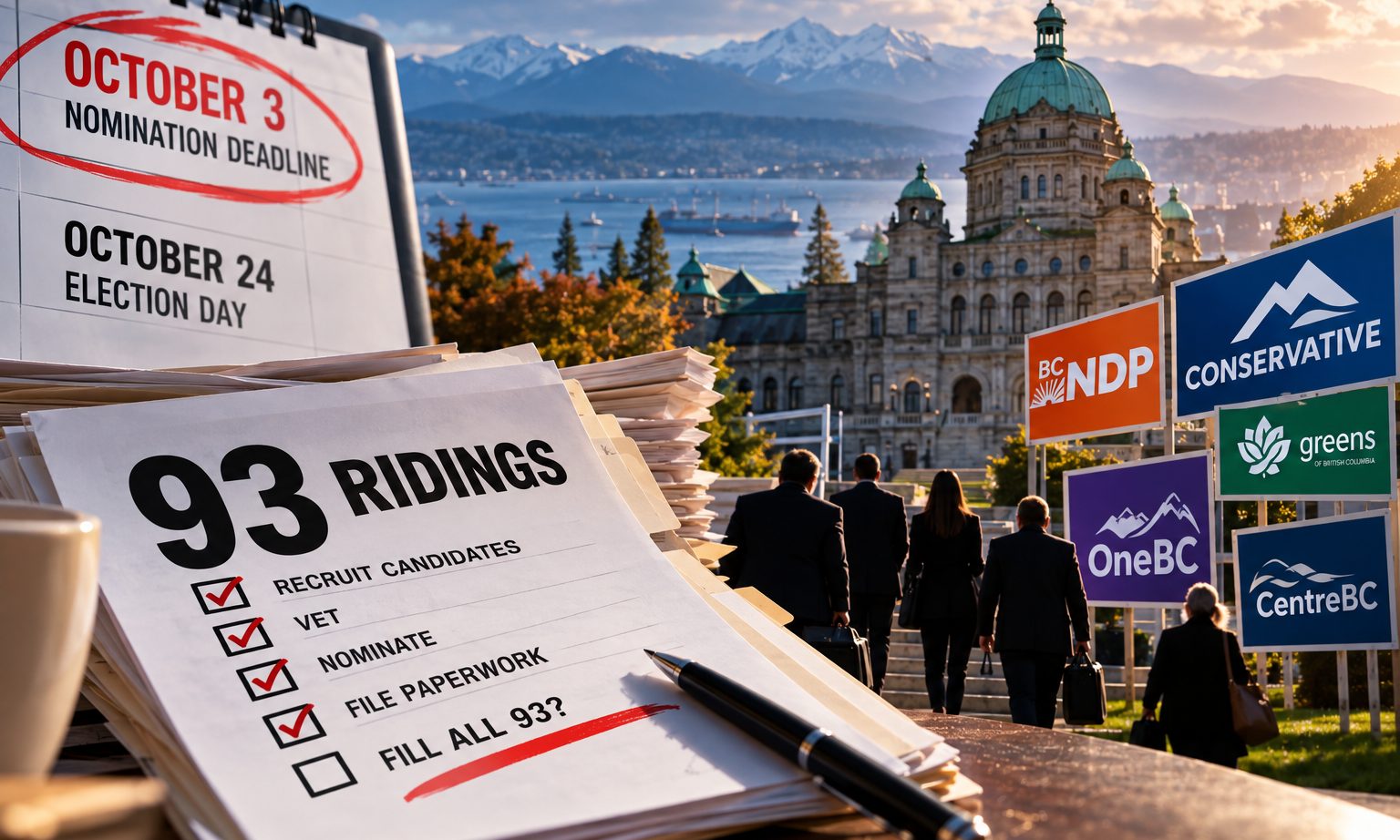
The writ has dropped, the clock is ticking, and before British Columbians decide who should govern, the parties have a more immediate problem: finding 93 people willing and able to run.
By Chad Dashly | The Current
British Columbia has an election.
Now the political parties need candidates.
All 93 of them.
When Premier David Eby called British Columbia’s snap provincial election on September 22, he didn’t simply launch another election campaign.
He launched what may be one of the largest and fastest political recruitment drives in recent B.C. history.
Final Voting Day is October 24.
Candidate nominations close at 1 p.m. on October 3.
That gave political parties just 11 days from the dropping of the writ to recruit candidates, vet them, complete the paperwork and get them officially nominated across 93 constituencies.
And as of September 30, nobody should assume every party is going to get there.
According to BC Ballot’s tracking of accepted Elections BC nominations and publicly announced candidates, the Conservatives have candidates identified in 72 of 93 ridings, the NDP in 54, OneBC in 15, the Greens in 14, and CentreBC in 13.
Those numbers are moving quickly, and there is an important distinction: some candidates have been announced by their parties but have not yet completed the formal Elections BC nomination process.
Elections BC itself cautions that its candidate list includes only people whose completed nominations have been accepted. The definitive list won’t exist until nominations close Saturday afternoon.
But even allowing for candidates waiting in the wings, the picture is remarkable.
Three days before nominations close, the two largest parties are still publicly assembling their teams.
The Conservatives need another 21 names to reach 93 based on the currently announced count.
The NDP needs another 39.
The Greens would need 79.
OneBC would need 78.
CentreBC would need 80.
Welcome to the 2026 British Columbia election.
Or perhaps more accurately:
Welcome to the scramble.
This Isn’t a Normal Election
In a regularly scheduled election, serious political parties can spend months — sometimes years — recruiting candidates.
They identify business leaders, municipal politicians, community advocates, lawyers, farmers, teachers, entrepreneurs and former elected officials.
They talk to riding associations.
They conduct background checks.
They examine social-media histories.
They interview prospective candidates.
They investigate whether something said on Facebook in 2014 is going to become tomorrow morning’s headline.
And ideally, local party members actually get an opportunity to decide who will represent them.
A snap election changes the equation.
Suddenly the question isn’t simply:
Who is the strongest candidate we can find?
It can become:
Who can we get nominated by Saturday?
Those are two very different questions.
And the consequences may last considerably longer than this campaign.
An MLA elected on October 24 could potentially sit in the Legislature for years.
Yet some of the people asking British Columbians for that responsibility may have been recruited, vetted and nominated within days.
That deserves more attention than it is getting.
Kelowna Gives Us a Perfect Example
Look no further than Kelowna-Lake Country-Coldstream.
Former Conservative MP Tracy Gray publicly announced that she was seeking the B.C. Conservative nomination on September 23, one day after the election was called.
Gray wasn’t an unknown quantity.
She had served on Kelowna City Council from 2014 until 2018.
She was elected to Parliament in 2019 and represented Kelowna-Lake Country federally until 2025.
Whatever anyone thinks of her politics, those are straightforward facts about her political résumé.
She had municipal experience.
She had federal experience.
She had fought multiple campaigns.
And she had represented much of the same community she was seeking to represent provincially.
But within hours, the Conservative Party announced Pavneet Singh as its candidate instead.
Singh also wasn’t completely new to provincial politics. He had previously been selected as a BC United candidate and currently serves as a vice-president of the Conservative Party of B.C.
When BC United withdrew from the 2024 election, Singh did not continue as an independent candidate.
Now he will carry the Conservative banner in Kelowna-Lake Country-Coldstream.
The point here isn’t to declare that Gray should have been selected instead of Singh.
That is a judgment for party members, party officials and ultimately voters.
The more interesting issue is the process.
Under normal circumstances, imagine what could have happened.
Gray could have sought the nomination.
Singh could have sought the nomination.
Perhaps others would have entered as well.
Conservative members in Kelowna-Lake Country-Coldstream could have attended meetings, listened to the candidates, asked questions and ultimately voted on who they wanted representing them.
Instead, the compressed election calendar produces a very different system.
The party has to make decisions quickly.
And sometimes those decisions are made extraordinarily quickly.
That makes the Gray-Singh situation an almost perfect illustration of one of the least discussed consequences of David Eby’s snap election.
Political parties aren’t merely campaigning.
They are building their teams while the game is already underway.
Who Decides What Makes a Good Candidate?
The situation raises questions that extend far beyond one Conservative nomination in the Okanagan.
What criteria are parties using right now?
Experience?
Local name recognition?
Party loyalty?
Ideological alignment?
Fundraising ability?
Internal relationships?
Community involvement?
The ability to survive media scrutiny?
Or simply the ability to say yes, complete the paperwork and get a campaign running before nominations close?
Those are legitimate questions for every political party.
Because filling 93 ballot positions isn’t the same thing as finding 93 people capable of serving as MLAs.
And that distinction matters.
An MLA helps decide how billions of public dollars are spent.
MLAs vote on laws.
They sit on committees.
They deal with constituency problems.
They represent communities during emergencies.
Some eventually become cabinet ministers responsible for major government departments.
This isn’t supposed to be a casting call.
Yet compressed election timelines inevitably make thorough candidate recruitment more difficult.
Every political party should therefore be asking prospective candidates some uncomfortable questions.
What has this person posted online?
What organizations have they belonged to?
What business or professional controversies might surface?
What statements have they made publicly?
Can they handle a hostile interview?
Can they raise money?
Can they organize volunteers?
Do they understand provincial issues?
Can they survive three weeks of intense scrutiny?
And perhaps most importantly:
Would we still nominate this person if we had six months instead of six days?
That might be one of the most important questions of this election.
The Conservatives Have a Particularly Complicated Job
For the Conservatives, the candidate scramble comes after an extraordinary period of internal upheaval.
The party that won 44 seats in 2024 enters this election looking considerably different.
Former Conservative MLAs left caucus during the term. New political formations emerged. The opposition landscape fractured.
That means the party isn’t simply replacing a handful of retiring candidates.
It is rebuilding parts of its political organization while simultaneously fighting an election.
Based on the September 30 candidate tracker, Conservatives have announced 72 candidates.
That is substantially closer to a full slate than any other party.
But it still leaves 21 constituencies without an identified Conservative candidate on the tracker with only days remaining.
Those final candidates may be among the most interesting.
Are they longtime Conservatives who were already preparing?
Former federal candidates?
Municipal politicians?
Business owners?
Community leaders?
Or people recruited because the party needs a name on the ballot?
We won’t know until the slate is complete.
The NDP Has Its Own Candidate Problem
The governing NDP has a different challenge.
It has the machinery of government behind its political organization, established constituency associations and numerous incumbent MLAs.
Yet as of September 30, BC Ballot lists NDP candidates in just 54 of 93 ridings, including both officially filed and party-announced candidates.
That leaves 39 constituencies without an identified NDP candidate on that tracker.
There may already be candidates moving through the nomination process.
Almost certainly more announcements are coming.
But again, look at the calendar.
October 3.
One o’clock.
That’s the deadline.
This isn’t theoretical anymore.
Then Come the Smaller Parties
The challenge becomes even greater for the smaller parties.
The Greens currently have candidates identified in 14 constituencies.
OneBC has 15 on the September 30 tracker.
CentreBC has 13.
For newer parties, fielding 93 candidates in a snap election is an enormous organizational undertaking.
They need candidates.
They need paperwork.
They need riding organizations.
They need volunteers.
They need money.
They need signs.
They need social media.
They need websites.
They need people knocking on doors.
And they need all of that almost immediately.
But here’s where this election gets particularly interesting.
The smaller parties don’t necessarily need 93 candidates to affect the outcome.
They need candidates in the right ridings.
British Columbia’s political landscape is considerably more fragmented than it was at the beginning of the last provincial campaign.
The Conservatives, CentreBC and OneBC are competing for portions of the electorate that may overlap in some constituencies.
The Greens remain another option for voters, particularly in ridings where environmental policy, housing and progressive politics feature prominently.
Independents may also matter.
That doesn’t mean votes automatically “belong” to another party.
They don’t.
Voters aren’t transferable commodities.
But British Columbia uses first-past-the-post.
And under first-past-the-post, relatively small changes in vote share can matter enormously.
Ask Kelowna Centre
We don’t need a hypothetical example.
Look at Kelowna Centre in 2024.
Conservative Kristina Loewen received 11,033 votes.
NDP candidate Loyal Wooldridge received 10,993.
The difference was 40 votes.
Forty.
Not four thousand.
Not four hundred.
Forty.
Meanwhile, independent Michael Humer received 2,613 votes and Green candidate Bryce Tippe received 1,111.
Nobody can legitimately assume where those voters would have gone in a two-candidate race.
But the numbers demonstrate the broader point.
In a constituency decided by 40 votes, every candidate matters.
Courtenay-Comox was decided by just 93 votes in 2024.
When margins become that narrow, a third, fourth or fifth candidate doesn’t have to win the riding to matter to its political dynamics.
That’s why the final candidate map after October 3 may tell us almost as much about this election as the province-wide polls.
And Those Polls Show a Fluid Electorate
A Leger survey conducted September 24–28 among 1,003 British Columbia adults found a substantial share of voters remained open to changing their minds. Leger reported that 28 per cent were likely to change their vote.
The survey also found there was no single dominant issue driving the election: health care ranked first at 15 per cent, followed by housing prices and affordability at 14 per cent and the economy at 13 per cent.
Leger notes that because the survey used a non-probability online sample, a conventional margin of error cannot technically be assigned to it.
In other words, this isn’t an electorate neatly divided into immovable camps.
There are voters still making decisions.
There are multiple parties competing for them.
And there are ridings that were decided by tiny margins just two years ago.
Candidate quality could matter.
A lot.
The First Election Night Is October 3
Everyone is focused on October 24.
I would circle another date first.
October 3.
That’s when nominations close and British Columbians finally get to see the actual battlefield.
Elections BC confirms that the final candidate list will be available after nominations close at 1 p.m. Pacific.
That’s when we find out:
Did the Conservatives reach 93?
Did the NDP?
How many candidates did the Greens manage to recruit?
Where did OneBC concentrate its resources?
Where did CentreBC decide it could realistically compete?
Which independents entered the race?
And which ridings were left without representation from one or more major parties?
Those aren’t minor administrative details.
They are part of the political story.
Because candidate recruitment is strategy.
A party without a candidate cannot win a constituency.
A party with an unsuitable candidate can create problems for itself.
And an effective local candidate can sometimes outperform broader party trends.
Ninety-Three Ridings. One Very Short Clock.
David Eby’s decision to call the election early didn’t simply shorten the campaign.
It compressed the entire political system.
Parties that expected years to prepare suddenly had days.
Potential candidates who thought they had months to consider running had hours.
Riding associations that might ordinarily organize nomination meetings instead find themselves waiting for announcements from party headquarters.
And voters who assumed they would have plenty of time to evaluate candidates may discover that some names on their ballots were barely candidates a few weeks earlier.
That doesn’t mean those people will make poor MLAs.
Some may turn out to be exceptional ones.
Political history is full of people who entered politics unexpectedly and proved highly capable.
But it does mean voters should pay particularly close attention to the names below the party logos this time.
Ask who these people are.
Ask what they have done.
Ask why they were selected.
Ask whether local members chose them.
Ask what experience they bring.
And ask what they actually believe.
Because once the campaign signs come down, one of these people may represent your community in Victoria.
British Columbia’s parties are racing toward October 24.
But before they can convince voters they are ready to govern, they have a much more immediate test.
They have to demonstrate that they can put together a team capable of governing.
Ninety-three constituencies.
Three days until nominations close.
Twenty-four days until British Columbia votes.
The campaign has begun.
The teams aren’t even finished yet.
Welcome to the scramble.
OPINIONS
Our frontline workers deserve safety, not empty promises on crime
Rising retail crime and violent attacks on B.C. grocery staff demand urgent action on repeat offenders to protect local workers and communities.

The Everyday Heroes on Our Front Lines
Every day, cashiers, stock people, and pharmacy workers wake up to serve our neighborhoods. They keep our pantries full, offer a friendly smile at the checkout, and form the backbone of local life. Yet, as Jamie Nelson, president of the Pattison Food Group, recently highlighted in an open letter, these essential workers are increasingly being put in harm’s way simply for showing up to do their jobs.
The situation has reached a critical breaking point. In Victoria, a store manager lost consciousness, suffered a concussion, and sustained severe injuries that will likely require surgical treatment after a brutal assault. Earlier this year, a arsonist deliberately set fire inside a Nesters Market store at Vancouver’s iconic Woodward’s building while staff and customers were inside. That attack caused over $500,000 in damage and temporarily closed the only full-service grocery store serving the Downtown Eastside. In the Okanagan, theft across Pattison Food Group stores has jumped 185 percent since 2021, while violent incidents against frontline security personnel rose by approximately 44 percent over the same period.
Personal Responsibility and Public Safety
Retail workers and local businesses are being subjected to bear spray attacks, knife threats, and violent altercations with homemade weapons. While Nelson rightly acknowledges the complex underlying issues surrounding addiction, mental illness, and homelessness, sympathy cannot come at the expense of basic public order. A compassion that ignores lawlessness is no real compassion at all—it leaves frontline staff exposed to constant fear and physical danger.
Local enterprise and practical community institutions cannot be expected to invest, provide essential services, or keep doors open without reasonable confidence that employees and customers are safe. When store operators spend heavily on security, training, and support programs only to see violent incidents escalate, it is clear that public authorities are failing in their most fundamental duty: maintaining public safety and holding repeat offenders accountable.
Protecting Those Who Build Our Communities
We cannot wait until a life is lost before deciding that enough is enough. As Nelson noted, the people most affected—the staff on the store floor—are often the least heard. They deserve to know that their safety matters, that violence will never be accepted as just another part of the job, and that they will return home safely at the end of every shift. It is time for every level of government to support our local workers with real accountability for repeat offenders rather than continued inaction.

Where Provincial Jobless Rates Stood in September
What New Brunswick’s Latest Unemployment Figures Mean for Your Community

Who Is Running in Your Riding for the 2026 BC Election?

How Central Okanagan Residents Can Avoid Costly Household Plumbing Damage This Thanksgiving

BC Supreme Court Judge Set to Rule on Sentence Length for Former Gang Member

Loss of Newborn Calf Puts Fresh Focus on Endangered Southern Resident Whales

Opinion: John Rustad Has to Go

B.C. Supreme Court Grants Cowichan Tribes Title to Historic Richmond Lands and Fishing Rights

Vancouver Canucks Gear Up for a Make-or-Break 2025–26 Season

Province to Appeal Cowichan Tribes Land Decision

Kamloops Prepares Four Reverse Referendums on $188M in Major Projects

Kamloops Blazers Announce Off-Season Changes Ahead of 2025–26 Season
-

 LOCAL7 days ago
Have You Seen Him? Public Help Sought in Locating Missing Traveller Last Seen in Kamloops
-

 BC STORIES7 days ago
Why a Familiar Political Name is Joining the Kamloops-North Thompson Race
-
LOCAL6 days ago
Your Current 3 Day Forecast — October 4, 2026
-

 LOCAL7 days ago
Two Displaced as Investigators Eye Suspicious Four-Plex Fire in Kelowna
-

 COMMUNITY4 days ago
Why Okanagan Pet Owners Turned to Free BC SPCA Clinics After Wildfire Season
-

 OPINIONS4 days ago
B.C. Election Poll Puts Conservatives Ahead Five Points as Cost of Living Tops Voters’ Concerns
-
 BC STORIES4 days ago
B.C. Patients Could Soon Select Surgical Lists Based on Wait Times Under NDP Plan
-
LOCAL3 days ago
Your Current 3 Day Forecast — October 7, 2026